Blue Light Therapy for Seasonal Depression: How It Works and What to Expect
Bright light therapy is a first-line treatment for seasonal affective disorder, backed by decades of controlled trials. The mechanism, the protocol that works, and its limits.
By LightTherapyIQ Editorial Team, Editorial
On this page
SAD Is a Circadian Disorder, Not Just a Mood Disorder
Seasonal affective disorder (SAD) affects approximately 2–3% of the US population, with another 10–20% experiencing milder "winter blues." The symptoms (low mood, fatigue, hypersomnia, carbohydrate craving, social withdrawal) follow a predictable seasonal pattern, typically beginning in October-November and resolving in March-April in northern latitudes.
The mechanism is primarily circadian: reduced winter daylight shortens the light signal received by the retina, which shifts the circadian phase later (delayed sleep phase), disrupts melatonin timing, and alters the serotonin system. This isn't analogous to general depression where the circadian component is secondary. For SAD, the circadian disruption appears to be central.
Light therapy works by delivering the missing light signal that shorter winter days fail to provide. It's physiological replacement rather than a pharmacological intervention.
The Mechanism: ipRGCs and the Circadian Clock
Photoreceptors in the retina called intrinsically photosensitive retinal ganglion cells (ipRGCs) project to the suprachiasmatic nucleus (SCN), the brain's master circadian clock. The photopigment in ipRGCs, melanopsin, has its peak absorption at approximately 480nm, in the blue portion of the visible spectrum.
Morning light exposure activates ipRGCs, which signal the SCN to suppress melatonin and shift the circadian phase earlier. In summer, this happens naturally through ambient daylight. In winter, the reduced light intensity and delayed sunrise means the SCN receives a weaker, later signal.
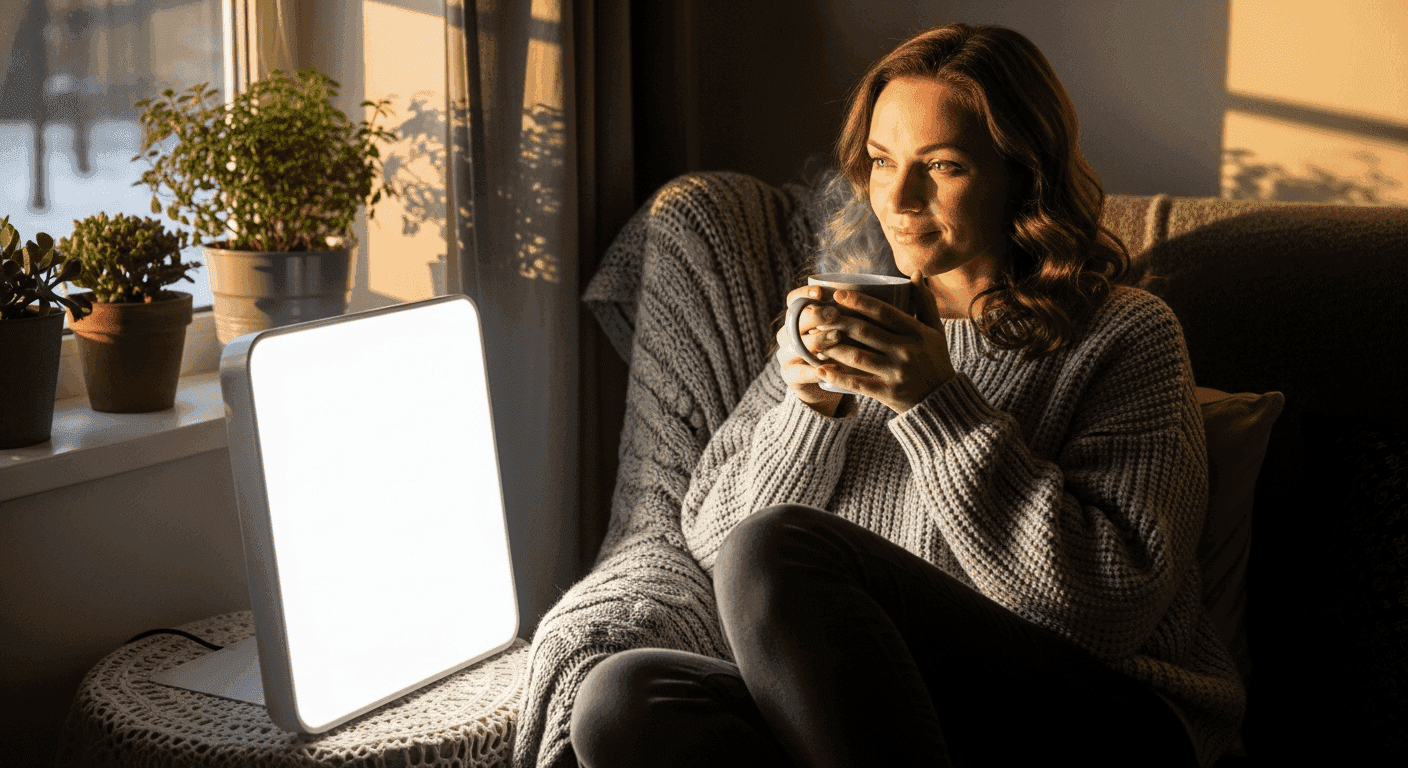
A bright light therapy lamp in the morning replicates the summer dawn signal: high intensity, blue-enriched, in the early morning window. This phase-advances the circadian clock, normalizing the relationship between sleep-wake timing, melatonin release, and daytime serotonergic activity.
The specific 480nm wavelength is where melanopsin absorbs most strongly. This is why blue-enriched white light, or narrow-band blue light devices, work at lower lux than standard white light boxes. The 10,000 lux standard for white boxes isn't arbitrary: white light has a relatively low proportion of blue content, requiring higher overall intensity to deliver sufficient blue photon dose to ipRGCs.
The Evidence
Bright light therapy for SAD has an unusually strong evidence base for a non-pharmacological treatment.
Randomized controlled trials consistently find bright light therapy more effective than control conditions for seasonal depression. Effect sizes are comparable to those for antidepressants in SAD, and several head-to-head RCTs found equivalent efficacy between light therapy and SSRIs.
The landmark comparison trial is the CAN-SAD study (Lam et al., 2006): 96 patients with SAD were randomized to bright light therapy or fluoxetine over eight weeks. The two treatments produced comparable response rates with no significant difference between them, though light therapy showed a faster initial response. This established light therapy as at least as effective as an SSRI for seasonal depression.
For non-seasonal major depression, the evidence is positive but less developed. A 2016 JAMA Psychiatry trial by Lam et al. found bright light therapy (alone and combined with fluoxetine) superior to placebo for non-seasonal depression, with light monotherapy reaching a 43.8% remission rate versus 19.4% for fluoxetine alone.
What Works: The Standard Protocol
Device: A full-spectrum bright white light box producing 10,000 lux at the specified treatment distance (typically 12–18 inches). White light boxes have the most evidence; blue-enriched white light boxes may require shorter sessions but have less trial validation.
Timing: Morning, within 30 minutes of waking. This is the critical variable. The circadian phase-advancing effect of bright light is strongest when delivered in the biological morning. Afternoon or evening use produces weaker or opposite phase effects.
Session duration: 20–30 minutes at 10,000 lux. Shorter sessions require brighter lamps; longer sessions are acceptable but don't proportionally increase benefit. The dose-response curve is relatively flat above 20–30 minutes.
Distance: Maintain the distance at which your lamp produces 10,000 lux (specified in the device documentation). Moving further away reduces lux geometrically.
Eye direction: The light should reach the eyes, but direct stare into the lamp is unnecessary. Having the lamp in your field of view while reading, eating breakfast, or working is sufficient. The therapeutic effect doesn't require staring.
Duration of treatment: Most users see response within 1–2 weeks of daily use. Continue through the end of the symptomatic season. Many SAD patients begin light therapy in October and continue through March.
Seasonal Timing and Response Rate
Response rates in controlled trials range from 40–70% in SAD populations. Non-responders exist, and light therapy isn't effective for everyone. The same is true of antidepressants. Factors that predict better response: starting treatment early in the season (before symptoms are fully established), consistent morning use, and using a lamp that produces 10,000 lux (many cheap consumer lamps don't).
First response typically appears within 3–5 days of daily morning use. Full response is usually evident at 2 weeks. If no improvement appears at 3 weeks of consistent use, the protocol may need adjustment (earlier timing, longer session, closer lamp distance) before concluding light therapy is ineffective for you.
Selecting a Lamp
The most common consumer mistake is purchasing an undersized lamp that doesn't produce 10,000 lux at a practical working distance. Lux falls with the square of distance. A lamp rated at 10,000 lux at 8 inches may produce 2,500 lux at 16 inches, where most people sit while using it.
Look for:
- Third-party tested 10,000 lux at a specified distance that matches normal working distance (12–16 inches)
- UV-filtered. Therapeutic light boxes don't require UV; UV at these intensities adds unnecessary risk
- Screen size. Larger panels allow more head movement while maintaining therapeutic field
- Color temperature. 5,000–6,500K produces blue-enriched white light appropriate for morning use; warmer temperatures are less effective per lux
Carex states 10,000 lux at 12 to 14 inches for the Day-Light Classic Plus. Northern Light Technologies states 10,000 lux at up to 14 inches for the BOXelite. Verilux states 10,000 lux for the HappyLight Luxe but gives no distance on its own product page. These are manufacturer figures, not our measurements. Many low-cost lamps claim 10,000 lux that doesn't hold up at a practical distance. Our SAD light box buyer's guide explains how to compare them.
Narrow-Band Blue Light Devices
Research on narrow-band 480nm blue light for SAD shows that equivalent therapeutic effect can be achieved at much lower overall light intensity (around 100 lux of pure blue light versus 10,000 lux of white light) because the active component (480nm photons reaching ipRGCs) is delivered more efficiently.
Consumer blue-enriched light boxes and some clinical devices use this principle. The evidence is promising but thinner than for the 10,000-lux white light standard. If a device claims to work as a SAD therapy at unusually low overall light output, check whether it has controlled trial evidence behind the specific product.
Contraindications and Cautions
Bipolar disorder. Bright light therapy can trigger hypomanic or manic episodes in bipolar patients, particularly those not on mood stabilizers. Psychiatric consultation before use is strongly recommended for anyone with bipolar diagnosis or history.
Retinal conditions. Patients with macular degeneration, diabetic retinopathy, or other retinal pathology should consult an ophthalmologist before using bright light boxes. High-intensity light exposure in eyes with compromised retinas carries additional risk.
Photosensitizing medications. The same drug categories that increase photosensitivity for skin applications apply to high-intensity light exposure to the eyes. Lithium, certain antidepressants, and St. John's Wort fall into this category.
Migraine with light sensitivity. Morning bright light sessions can trigger migraines in photosensitive patients. Start with lower-intensity exposure or shorter sessions and assess tolerance.
Combining Light Therapy With Other SAD Treatments
For moderate-to-severe SAD, combining bright light therapy with an antidepressant produces additive benefit in multiple trials. Light therapy provides faster initial response (days versus weeks for SSRIs); the SSRI provides sustained benefit. For patients who want to minimize medication or achieve remission without antidepressants, light therapy alone achieves response rates comparable to SSRIs in head-to-head trials.
Cognitive behavioral therapy adapted for SAD (CBT-SAD) combined with light therapy has shown more sustained benefit across subsequent winters than light therapy alone in at least one RCT, suggesting a behavioral component addresses the learned helplessness and avoidance patterns that perpetuate seasonal low mood.
LightTherapyIQ covers the clinical evidence on light therapy devices. No manufacturer pays for editorial coverage.