Infrared Sauna Benefits: What the Research Actually Supports
Infrared saunas produce heat through far-infrared radiation rather than convection. The cardiovascular and pain evidence is meaningful; the detox and weight-loss claims are not.
By LightTherapyIQ Editorial Team, Editorial
On this page
How Infrared Saunas Differ From Traditional Saunas
A traditional Finnish sauna heats the air in the room to 80–100°C. The body responds to the hot ambient air through convective heat transfer: the hot air touching your skin and the radiant heat from the hot rocks. Core body temperature rises as a secondary effect of this surface heating.
An infrared sauna operates at much lower ambient temperatures (45–65°C) but directly heats body tissue through far-infrared radiation (FIR) in the wavelength range of 5–15 micrometers (5,000–15,000nm). FIR penetrates superficially into skin (a few millimeters) and generates heat within the tissue itself rather than through air-to-skin transfer. The result is a comparable core temperature rise at lower ambient temperature.
The practical difference: infrared saunas are more comfortable to breathe in, achieve similar cardiovascular effects at lower session temperatures, and work in the form factor of blankets and portable enclosures that traditional saunas can't.
Both formats produce the same fundamental physiological response: sustained core temperature elevation, cardiovascular stress response, heat shock protein induction, and profuse sweating. The FIR heating mechanism is a delivery difference, not a fundamentally different physiology.
Cardiovascular Evidence: The Strongest Data
The most rigorous evidence for sauna benefits comes from Finnish longitudinal research, most significantly the KIHD (Kuopio Ischemic Heart Disease) cohort study by Laukkanen et al.
A 2015 JAMA Internal Medicine paper by Laukkanen et al. followed 2,315 middle-aged Finnish men over 20 years. Compared to once-weekly sauna use, men who used the sauna 4–7 times per week had a 63% lower risk of sudden cardiac death, a 50% lower risk of fatal cardiovascular disease, and a 40% lower risk of all-cause mortality. These are observational associations, not causal trials — but the dose-response relationship (more sauna, more benefit) and the magnitude of the associations are compelling.
The proposed mechanisms: repeated heat stress produces cardiovascular adaptations similar to moderate-intensity aerobic exercise, including increased stroke volume, reduced resting heart rate, improved endothelial function and arterial compliance. A 2018 systematic review by Laukkanen, Laukkanen, and Kunutsor in Mayo Clinic Proceedings confirmed that sauna bathing is associated with cardiovascular and all-cause mortality risk reduction across available evidence.
A separate RCT by Imamura et al. (1999) in the Journal of the American College of Cardiology used far-infrared sauna specifically in patients with chronic heart failure. Two weeks of daily far-infrared sauna use improved exercise tolerance, reduced symptoms, and normalized cardiac function markers compared to a control group receiving standard treatment only. This trial demonstrated that infrared sauna specifically produced measurable hemodynamic improvements in a clinically relevant population.
Pain and Musculoskeletal Benefits
Chronic pain and fibromyalgia. A 2008 clinical study by Matsushita et al. found that Waon (far-infrared sauna) therapy significantly reduced pain and fatigue scores in fibromyalgia patients over a 12-session protocol. The mechanism involves a combination of direct tissue heating reducing muscle spasm, reduced inflammatory mediators, and possible central pain modulation through heat shock protein activation.
Rheumatoid arthritis. A small RCT (Oosterveld et al., 2009) found FIR sauna produced significant short-term reduction in pain and stiffness in RA patients, with good tolerability. This was a pilot study, and replication in larger trials is lacking, but the signal is positive.
Low back pain. Two RCTs on FIR sauna for chronic low back pain found significant pain reduction compared to controls. The thermal relaxation of paraspinal muscles and reduced inflammatory tone in the treated area explain most of the mechanism.
Detoxification: What the Evidence Supports
Sweating during sauna does increase the excretion of certain heavy metals and some fat-soluble compounds through sweat. A review by Genuis et al. (2011) analyzed sweat content and found elevated concentrations of cadmium, arsenic, lead, and mercury in sweat versus blood in some subjects.
The nuanced view: sweat is not a primary elimination route for most toxins. The liver and kidneys handle the vast majority of metabolic waste removal. Sweating contributes at the margins. The popular notion that sauna sessions dramatically "detoxify" the body overstates the effect. What's accurate: sauna sweating does produce measurable excretion of some heavy metals and environmental toxins in sweat, and may meaningfully contribute to heavy metal reduction over long-term use.
Mental Health and Stress Effects
Sauna produces significant autonomic nervous system effects. The heat stress response activates the sympathetic nervous system during the session, followed by parasympathetic dominance during the cool-down. The subjective experience of relaxation that follows a sauna session reflects this parasympathetic rebound.
Endorphin release during sauna has been documented, with some research suggesting that regular sauna use produces adaptations in stress response systems similar to exercise training. A 2018 study found regular sauna use associated with reduced depressive symptoms in a Finnish population cohort, though direction of causality is unclear from observational data.
Heat Shock Proteins
Sustained core temperature elevation triggers heat shock protein (HSP) synthesis, particularly HSP70 and HSP90. HSPs are cellular chaperone proteins that help repair damaged proteins, support cellular stress responses, and have anti-inflammatory properties. This is the same response triggered by fever and by exercise.
Regular sauna-induced HSP production has been proposed as a mechanism for some of the cardiovascular and longevity associations, though isolating HSP-specific effects in human studies is difficult. The biological rationale is solid; the clinical evidence for HSP-mediated sauna benefits specifically is still being developed.
Consumer Infrared Sauna Formats
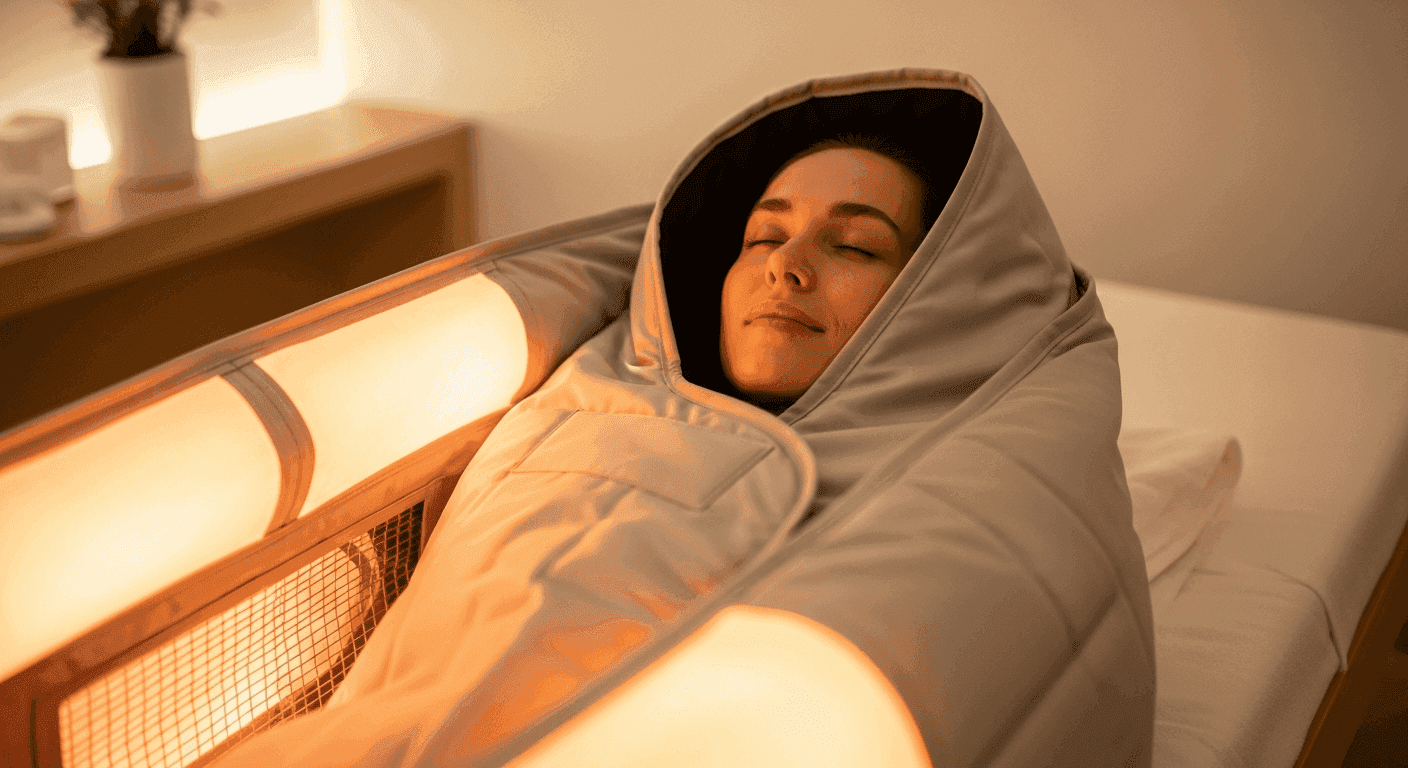
Sauna blankets: Portable, store easily, price range $150–$700. Enclose the body in a heated FIR-emitting textile. Most practical for home use. Limitation: can't easily cool the air around the face while heating the body.
Portable sauna tents/domes: Larger coverage at similar price points. Head typically remains outside the enclosure. Allow normal breathing in ambient temperature air while the body heats.
Built-in infrared sauna cabins: $2,000–$10,000+, permanent installation. FIR panels line the walls. Closest to traditional sauna experience.
Panels alone: Some users add FIR panels to existing sauna structures or use panel-format devices for targeted heat treatment.
For sauna blanket use: session temperatures of 45–55°C body surface, 20–45 minutes per session, 3–5x per week replicates the frequency range used in most positive trials. Hydration before and after is essential.
What the Evidence Doesn't Support
Weight loss. Infrared saunas are marketed for weight loss in some contexts. Fluid loss during a sauna session can produce 1–2kg of scale weight change, fully recovered within hours of rehydration. Fat loss through sauna use is not supported by controlled trial evidence at a meaningful magnitude.
Deep tissue cancer treatment. Hyperthermia (controlled whole-body or local heat application) is a legitimate adjunct in some cancer treatment protocols, but this is clinical medicine administered under oncological supervision at controlled temperatures. Consumer infrared saunas are not a cancer treatment.
Acute infection treatment. Sauna use during active infection (fever, flu, acute viral illness) is contraindicated: additional heat stress while the body is already mounting a fever response can be dangerous. The "sweat out a cold" approach is not evidence-based.
Safety Considerations
Cardiovascular disease: Patients with moderate-to-severe cardiovascular disease should consult a cardiologist before regular sauna use. Paradoxically, the cardiovascular evidence is strongest in cardiac populations for some benefits, but supervised introduction is appropriate.
Pregnancy: Sauna use raises core temperature. Elevated core temperature above 38.9°C in the first trimester is associated with neural tube defect risk. Conservative guideline: avoid high-intensity sauna use during pregnancy.
Alcohol use: Sauna combined with alcohol significantly increases cardiovascular risk. Many sauna-related deaths involve alcohol. Do not combine.
Medication interactions: Diuretics, beta-blockers, and some antihypertensives interact with heat stress and sweating. Check with a prescribing physician if on these medications.
LightTherapyIQ covers the clinical evidence on light therapy devices. No manufacturer pays for editorial coverage.