How to Use Red Light Therapy: Distance, Duration, and Protocol
Getting red light therapy right comes down to four variables: wavelength, irradiance, dose, and consistency. How to set a protocol that matches the clinical evidence.
By LightTherapyIQ Editorial Team, Editorial
On this page
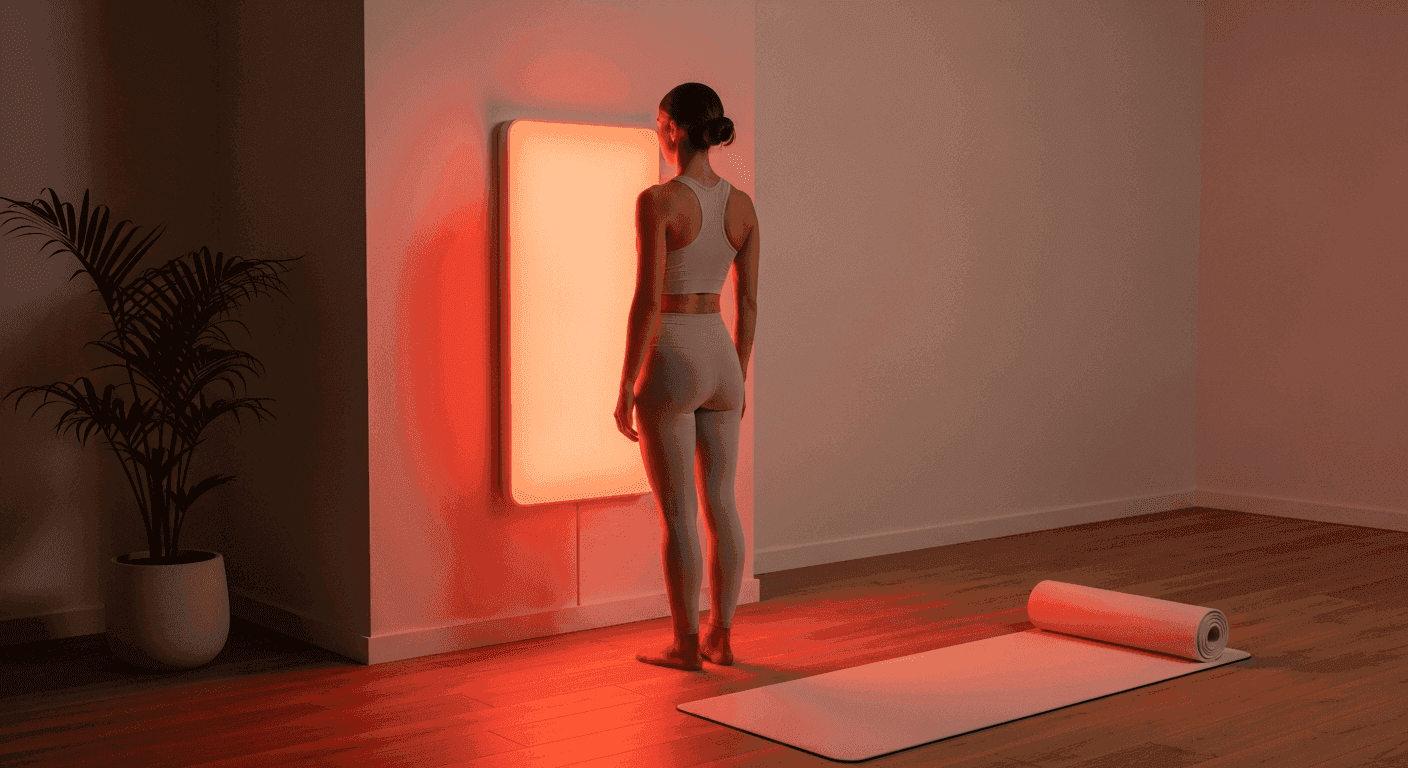
Most People Use Their Device Wrong
Not dangerously wrong; there's little harm in low-dose red light exposure. But ineffectively wrong. The most common pattern: purchase a panel, use it 3–4 times, see nothing happen, conclude it doesn't work. The biology requires weeks of consistent treatment. The dose requires being close enough to the device to actually deliver therapeutic photons to the target tissue.
Getting this right isn't complicated. It requires understanding four variables: wavelength, irradiance, dose, and treatment location. Everything else follows from those.
Variable 1: Wavelength
Two wavelength ranges matter for most consumer applications:
Red (630–660nm): Penetrates 1–2mm into tissue. Effective for the skin layer — collagen, dermis, surface wounds, acne. Visible as red light.
Near-infrared (810–850nm): Penetrates 3–5cm depending on tissue density. Effective for deeper targets: muscle, joints, bone surface, peripheral nerves. Invisible to the naked eye.
Most quality consumer panels include both. Choose your dominant wavelength based on your primary goal:
| Goal | Primary Wavelength |
|---|---|
| Wrinkle reduction, collagen | 630–660nm |
| Wound healing | 630–670nm |
| Hair growth | 630–670nm |
| Muscle recovery | 850nm |
| Joint pain | 810–850nm |
| Deep tissue inflammation | 850nm |
| Combined skin + deep | Both (630 + 850nm) |
If your panel is labeled "660nm + 850nm" and you're using it for knee pain, the 850nm LEDs are doing the work. The 660nm adds skin-level benefit but doesn't penetrate to the joint capsule.
Variable 2: Irradiance
Irradiance is the power delivered per unit area, measured in milliwatts per square centimeter (mW/cm²). It's the single most important spec for determining whether a panel will produce clinical-level doses.
The problem: most panels market their total wattage, not irradiance. Wattage on the box is wall draw, not light reaching your skin; true optical output is far lower, spreads across the panel area, and then falls with the square of distance to the treatment surface. (See the dosing guide for the full wattage-to-irradiance breakdown.)
Minimum useful irradiance at the skin: 30 mW/cm² Target for most applications: 50–100 mW/cm² Clinical device range: 100–200 mW/cm²
Third-party irradiance measurements at specific distances are the only reliable figure. Reputable manufacturers publish these. If a panel's spec sheet only shows "total wattage" or "LED count," the irradiance at your skin is unknown.
Variable 3: Dose
Dose is the product of irradiance and time, measured in joules per square centimeter (J/cm²):
Dose (J/cm²) = Irradiance (mW/cm²) × Time (seconds) ÷ 1000
Effective doses in published trials fall between 4 J/cm² and 60 J/cm² depending on condition and tissue depth. Here's what typical doses look like with a quality panel at 60 mW/cm²:
| Time at 60 mW/cm² | Dose |
|---|---|
| 2 minutes | 7.2 J/cm² |
| 5 minutes | 18 J/cm² |
| 10 minutes | 36 J/cm² |
| 15 minutes | 54 J/cm² |
| 20 minutes | 72 J/cm² |
For skin applications, 10–20 J/cm² is the typical target range. For pain at deeper tissues, 10–40 J/cm² per treatment site is more common. For muscle recovery, trials used 20–60 J/cm² applied to specific muscle groups.
Higher is not always better. The Arndt-Schulz biphasic dose-response curve means that at very high doses, cell function can be inhibited rather than stimulated. Consumer panels rarely reach the inhibitory range in normal 10–20 minute sessions, but sessions exceeding 40 minutes at high irradiance push into territory that may be counterproductive.
Variable 4: Treatment Location and Distance
Distance to the panel is the primary lever for controlling dose. Irradiance falls with the square of distance (the inverse square law). A device measured at 6 inches delivers roughly 4x more irradiance than at 12 inches.
Standard treatment distance: 6 inches (15cm) for most panels Close treatment: 2–4 inches for targeted work (joint, wound, specific skin area) Too far: More than 12 inches reduces irradiance below therapeutic thresholds for many consumer panels
Panel size matters for body area coverage. A small panel (roughly 30x15cm) covers the lower face or a single joint site. Full-back coverage requires either a large panel or repositioning. Don't spread a small panel's irradiance too thin by treating large areas — concentrate the session on specific target tissues.
Building a Protocol by Goal
Skin (Collagen, Wrinkles, Texture)
- Wavelength: 630–660nm (plus 850nm if available)
- Distance: 6–8 inches
- Duration: 10–20 minutes per session
- Frequency: 4–5x per week initially; 3x/week for maintenance
- Course: 8–12 weeks for visible collagen-related changes
- Body positioning: Panel faces the target skin area; stay still to maintain consistent distance
Joint and Musculoskeletal Pain
- Wavelength: 810–850nm
- Distance: 3–6 inches to the target joint
- Duration: 5–15 minutes per joint site
- Frequency: Daily for acute pain; 3–5x/week for chronic conditions
- Course: 4–8 weeks, assess response at 4 weeks
Muscle Recovery
- Wavelength: 850nm
- Distance: 3–6 inches to the muscle group
- Timing: Pre-exercise (30–60 minutes before) or post-exercise (within 2 hours); both have trial support
- Duration: 10–20 minutes per muscle group
- Frequency: As needed per training session; not every day for same muscle group unless recovery is the goal
Hair Growth
- Wavelength: 630–670nm
- Distance: 3–6 inches from scalp
- Duration: 15–20 minutes per session, cover full treatment area
- Frequency: 2–3x per week (not daily)
- Course: 16–26 weeks minimum
Practical Session Setup
1. Measure your device's irradiance. If you don't have a third-party measurement, find a review that includes meter measurements for your panel at your intended distance. Manufacturer specs are frequently overstated.
2. Calculate your dose before each session. If irradiance is 60 mW/cm² and you want 20 J/cm²: 20,000 mJ ÷ 60 mW = 333 seconds ≈ 5.5 minutes. Simple arithmetic, consistent results.
3. Use eye protection. Red and NIR light at therapeutic irradiances can cause retinal damage with direct stare over time. Most panels come with goggles; use them. Looking away or closing your eyes is not sufficient protection for extended face treatment.
4. Don't treat through clothing. Most clothing absorbs red and NIR wavelengths. Direct skin contact or very thin fabric only.
5. Clean, dry skin. Lotions, oils, and sunscreen can absorb light and reduce penetration. Treat before applying products.
6. Track your sessions. Treatment effects are cumulative. Missing sessions interrupts the response curve. A simple log of dates, duration, and areas treated helps assess response at the 4-week and 8-week marks.
Common Mistakes
Too far away. Users who stand 2–3 feet from a panel receive a fraction of the labeled irradiance. At 3 feet from a panel measured at 100 mW/cm² at 6 inches, you're receiving under 12 mW/cm². Sessions of 20 minutes at that distance deliver the same dose as 2.5 minutes at the correct distance.
Too short a treatment course. Two weeks isn't a test. Eight weeks is the minimum for skin. Sixteen weeks is the minimum for hair.
Wrong wavelength for the goal. Using a 660nm-only panel for knee pain won't deliver meaningful irradiance to the joint capsule. Near-infrared is required for deep-tissue applications.
Inconsistent schedule. Red light therapy results are cumulative and reversible. Missing a week mid-protocol isn't catastrophic, but irregular use (2 sessions this week, none for 10 days) doesn't produce the response curves shown in consistent-protocol trials.
No eye protection. This is the one safety concern worth emphasizing. The retina doesn't have pain receptors, so you won't feel damage from direct stare. Use goggles.
How Long Until You See Results
The timeline depends entirely on the application:
- Inflammation and acute pain: Days to weeks
- Skin texture and surface collagen changes: 8–12 weeks
- Deep wrinkle reduction and significant collagen remodeling: 12–16+ weeks
- Hair count increases: 16–26 weeks
- Chronic pain management: 4–8 weeks for meaningful change
These are the timelines from clinical trials. Consumer devices used at correct doses on consistent schedules should produce comparable results. Devices used at low doses on irregular schedules will produce nothing.
LightTherapyIQ covers the clinical evidence on light therapy devices. No manufacturer pays for editorial coverage.