Red Light Therapy at Home vs. Professional Treatment: An Honest Comparison
Clinical red light therapy devices cost $5,000–$50,000 and are used by trained practitioners. Consumer panels cost $200–$3,000. What the price gap does and doesn't buy you in results.
By LightTherapyIQ Editorial Team, Editorial
On this page
The Question Worth Asking
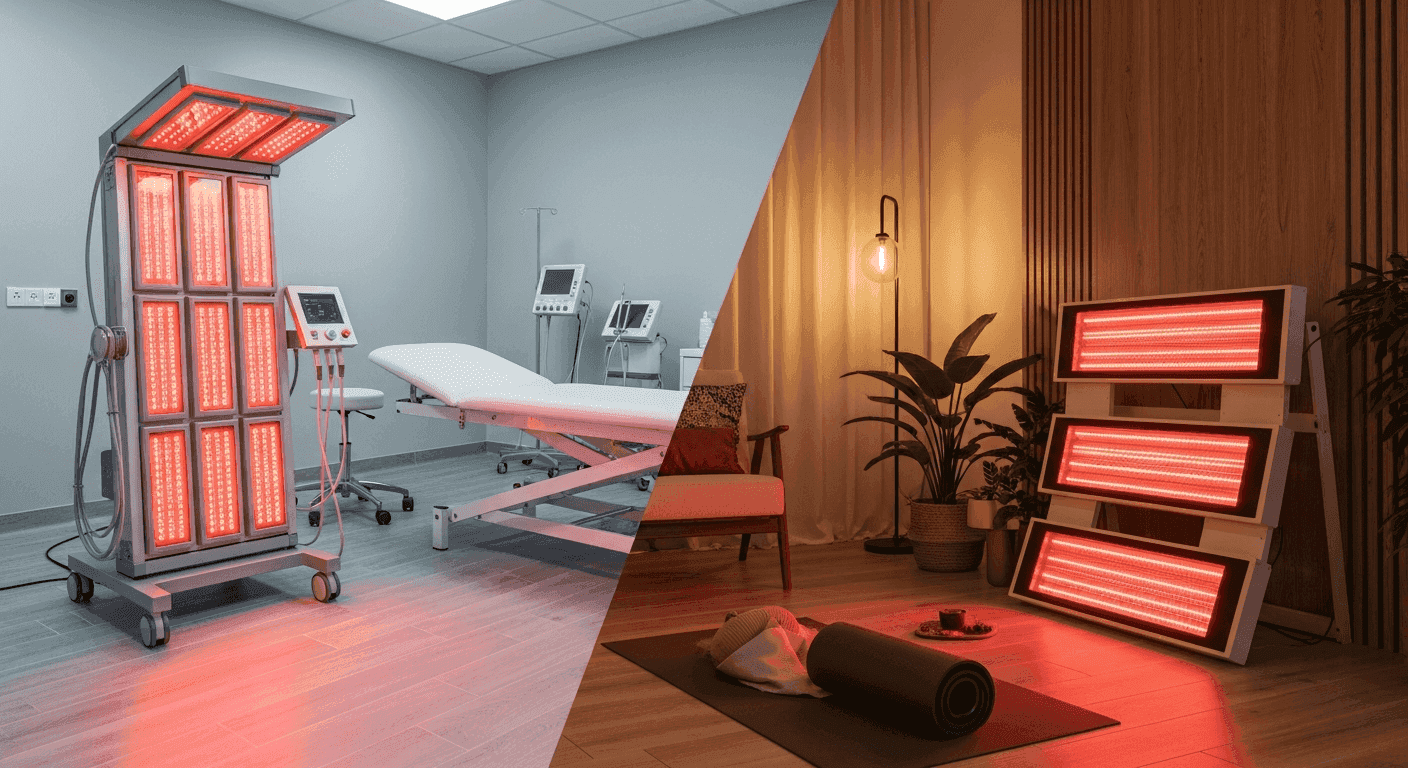
Before spending $800 on a home panel or $150 per session at a wellness clinic, it's worth understanding what you're buying. Clinical and consumer devices use the same fundamental technology: LED or laser arrays at specific wavelengths. The differences are real but often misrepresented in both directions.
Some wellness clinics imply that only professional equipment produces results. Some consumer panel brands imply their devices match clinical-grade performance. Neither claim is fully accurate.
What Clinical Devices Actually Offer
Professional photobiomodulation systems from manufacturers like Erchonia, MedX Health, and Thor Photomedicine cost between $5,000 and $50,000+. They're used by physiotherapists, dermatologists, pain specialists, and sports medicine practitioners. The clinical advantages are:
Calibrated and verified irradiance. Clinical devices are tested at manufacture and often recalibrated annually. The practitioner knows with precision how much energy is being delivered per session. That precision is what enables adherence to WALT dosing guidelines for specific conditions.
Larger treatment heads with consistent geometry. Clinical devices are designed to maintain specific irradiance-to-distance ratios at their treatment heads, without the variation that comes from consumer panels used at inconsistent distances.
Practitioner knowledge. A trained practitioner identifies the correct wavelength for the condition, positions treatment appropriately, and adjusts the protocol based on response. This is particularly relevant for pain applications where specific anatomical points (trigger points, neural structures) require targeted treatment, not general panel exposure.
Laser vs. LED for specific applications. Many clinical devices use laser emitters rather than LEDs. Laser light is coherent (all photons traveling the same direction) and monochromatic (a single precise wavelength). Some research suggests laser produces stronger effects than LED at the same irradiance, though this is debated. Consumer devices use LEDs almost exclusively.
Documentation and protocol consistency. Clinics track sessions, document response, and adjust protocols over time, the kind of systematic approach that mirrors how clinical trial protocols are designed.
Where Consumer Panels Have Caught Up
The consumer market has improved substantially over the past decade. Brands like Joovv, Mito Red Light, and PlatinumLED publish third-party irradiance measurements, spectral analysis from spectrometers, and flicker-rate data. The best consumer panels:
Deliver clinically relevant irradiance. Quality consumer panels measure 80–150 mW/cm² at 6 inches, well within the range used in positive clinical trials. That range describes the $500–$2,000 panel whose manufacturer publishes irradiance data from a Solarmeter or calibrated radiometer, not the $100 Amazon panel delivering 15 mW/cm² at 6 inches.
Cover larger body areas. A full-length consumer panel covers the entire back, torso, or legs in a single session. Clinical panels often have smaller treatment heads requiring multiple repositions.
Enable consistent home use. Most positive clinical outcomes in red light therapy trials involve 3–5 sessions per week over 8–16 weeks. Daily access to a home device makes this achievable. A clinical schedule of 2x/week (which is typical) means fewer total sessions over the same period.
Eliminate per-session cost over time. A $1,500 consumer panel, used 4x/week over 2 years, costs roughly $3.60 per session. Clinical sessions typically run $50–$150 each. Break-even on most quality consumer panels occurs within 3–6 months of regular use.
Where Clinical Treatment Is Worth the Cost
For specific conditions and goals, professional treatment produces better outcomes than home use:
Acute injury and post-surgical recovery. A practitioner treating a fresh injury or post-surgical site can apply precise doses to specific tissue depths with clinical-grade devices. The targeted, calibrated approach produces faster initial response than general panel use.
Photodynamic therapy (PDT) for skin conditions. PDT for actinic keratoses, certain skin cancers, and severe acne involves applying a photosensitizing agent (aminolevulinic acid) before light exposure. This is a clinical procedure: the sensitizer dramatically increases light reactivity and requires medical supervision. Consumer panels are not appropriate for this application.
Complex pain conditions with specific neural targets. For conditions requiring treatment of specific trigger points, nerve entrapments, or joint structures at measured doses, a practitioner who can position the device correctly and track response produces more reliable outcomes than self-administered home treatment.
Conditions requiring diagnosis and monitoring. Treating a condition with red light therapy before it has been properly diagnosed risks addressing the wrong problem. Professional consultation (separately from the therapy itself) ensures you're treating the right thing.
A Realistic Performance Comparison
For the most well-studied consumer applications (skin collagen, pattern hair loss, generalized musculoskeletal pain maintenance), quality home devices at correct protocols produce results that are comparable to clinical treatment. The clinical trial evidence for these applications was largely generated with equipment that modern consumer panels can replicate in the relevant parameters.
The performance gap is largest for:
- Conditions requiring precise anatomical targeting
- Situations where a practitioner's protocol expertise is a significant factor
- Applications involving clinical-only procedures (PDT, diagnostic-guided treatment)
The performance gap is smallest for:
- Consistent maintenance treatment (skin anti-aging, pain management)
- Large-area treatment (back, full body)
- Conditions where the dose required is within consumer panel range and the target anatomy is accessible
Evaluating Consumer Panels Honestly
The consumer panel market has a significant quality spread. The $150 panels on Amazon and the $2,000 panels from dedicated manufacturers are not equivalent. The relevant specs to compare:
Irradiance (mW/cm²) at stated distance: Third-party measured, not estimated. Solarmeter 6.5 or similar device at 6 inches. This is the number that determines dose delivery.
Spectral output: Do the LEDs peak at the stated wavelength? Spectrometer data (not a graph from the LED manufacturer's datasheet) confirms this. Meaningful for applications targeting specific absorption peaks.
Flicker rate: Some LEDs flicker at line frequency (60 Hz in North America). Extended exposure to flickering light can contribute to headaches and eye strain. Flicker-free panels are worth paying for.
EMF output: Near the panel, magnetic fields from power supplies and LED drivers can be elevated. Quality panels use cable management and design features to reduce EMF at treatment distances.
Build quality and warranty: A panel you'll use 4x/week for 2–3 years needs to last. Warranty terms (typically 2–3 years for quality brands) reflect manufacturer confidence in the product.
The Practical Decision Framework
Go clinical if:
- You're treating an acute injury or post-surgical site
- You need a proper diagnosis before treating
- The condition is complex (chronic pain with neural components, photosensitive skin conditions)
- You want to trial the therapy before committing to a home device purchase
Buy a quality home panel if:
- Your goal is skin maintenance, hair loss, or general musculoskeletal pain
- You can commit to 3–5 sessions per week over 8+ weeks
- You're willing to research irradiance data and set a real protocol
- The math on per-session cost favors home use (typically within 3–6 months)
Avoid both if:
- You're expecting results from casual, inconsistent use
- The condition being treated requires medical diagnosis or management
- You're drawn to $100–$200 panels because they look similar to $1,000 panels (they're not)
LightTherapyIQ covers the clinical evidence on light therapy devices. No manufacturer pays for editorial coverage.