Red Light Therapy for Pain: The Evidence by Condition
Red and near-infrared light therapy reduces pain in several musculoskeletal conditions with controlled trial support. What works, what doesn't, and the doses that matter.
By LightTherapyIQ Editorial Team, Editorial
On this page
The Pain Evidence Is Real but Conditional
Red light therapy reduces pain. That conclusion comes from multiple Cochrane reviews and several high-quality meta-analyses covering thousands of patients, not from marketing. But the evidence is specific to conditions, doses, and treatment protocols. It doesn't generalize to "red light treats pain," and it certainly doesn't mean any consumer panel at any distance will produce the same results.
Understanding which conditions have solid evidence, what doses produced those results, and how consumer devices compare to clinical equipment is what separates a useful tool from an expensive placebo.
The Mechanism: How Light Reduces Pain
Three pathways explain most of the analgesic evidence:
Mitochondrial ATP production. Pain-sensing nerve cells (nociceptors) require energy to maintain their electrochemical thresholds. When ATP production is compromised by chronic inflammation, nociceptors become hypersensitive. Red and near-infrared light, by activating cytochrome c oxidase, raises ATP output in nociceptor mitochondria and helps restore normal sensitivity thresholds.
Inflammatory mediator reduction. PBM (photobiomodulation) suppresses several pro-inflammatory cytokines including prostaglandin E2 (PGE2), interleukin-1β (IL-1β), and tumor necrosis factor-alpha (TNF-α). These are the same mediators that NSAIDs target pharmacologically. The light achieves this through NF-kB pathway modulation — reduced NF-kB activity means less downstream inflammatory signaling.
Nitric oxide release. The same NO displacement that triggers mitochondrial activation also releases free nitric oxide into surrounding tissue. NO is a vasodilator: blood flow increases to the treated area, facilitating waste clearance, reducing edema, and supporting tissue repair.
Neck Pain: The Strongest Evidence
The most cited evidence for LLLT and pain is the 2009 Lancet systematic review by Chow et al., which analyzed 16 randomized controlled trials involving 820 patients. The review found that LLLT reduced acute and chronic neck pain significantly compared to sham treatment immediately post-treatment and at up to 22 weeks follow-up.
The number needed to treat (NNT) for a clinically meaningful pain reduction was approximately 4, which compares favorably to many pharmacological options for the same indication. An NNT of 4 means for every 4 patients treated, one achieves pain relief they wouldn't have gotten from placebo.
This is published in The Lancet, not a supplement company's blog. The effect is real, the evidence is rigorously reviewed, and the clinical significance is meaningful.
Wavelengths in the reviewed trials spanned 780–860nm (near-infrared range). Doses in effective trials clustered around 0.1–10 J/cm² per point, applied to specific cervical trigger points and paraspinal muscles, targeted treatment rather than general panel exposure.
Knee Osteoarthritis
Bjordal et al. (2007) published a meta-analysis in the British Medical Journal covering 11 trials on LLLT for knee osteoarthritis. Pooled results showed clinically meaningful pain reduction compared to sham, particularly in trials using doses above 4 J/cm². Effect sizes were modest but consistent.
The World Association for Laser Therapy (WALT) publishes dosing guidelines for knee OA specifically: 4–12 J/cm² per point, applied to 4–6 points around the knee, 3x/week for 4–8 weeks. These guidelines synthesize the positive trial data and represent the best current evidence on what dosing produces benefit.
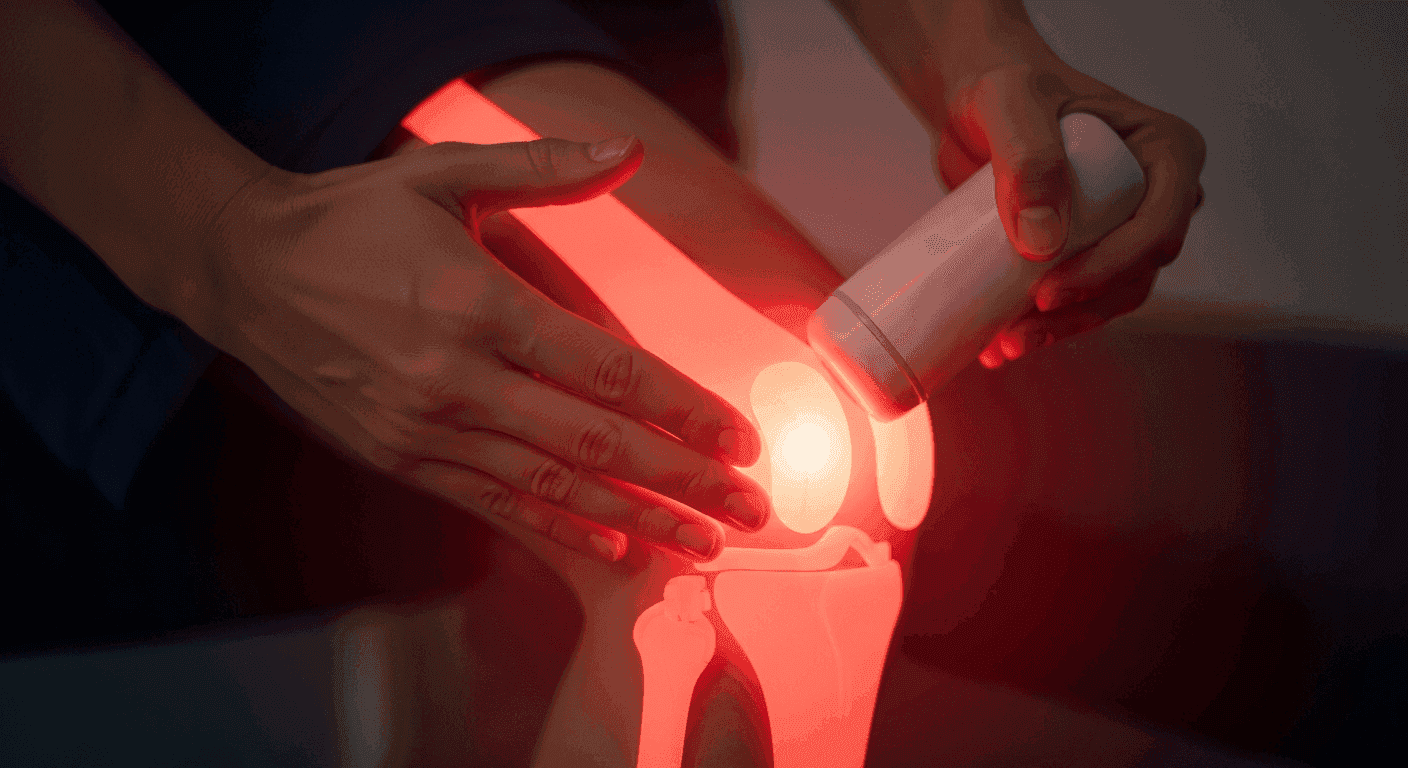
Consumer panels can deliver these doses. A panel with 50 mW/cm² irradiance at 6 inches, held for approximately 80–240 seconds per point, delivers 4–12 J/cm². The practical challenge is applying the treatment to specific joint points rather than diffuse whole-leg exposure. Targeted application (resting the panel on the knee or treating each point separately) matches the protocols that showed benefit.
Low Back Pain
The evidence here is mixed and less compelling than for neck pain or knee OA.
A 2008 Cochrane review found insufficient evidence to draw firm conclusions on LLLT for low back pain. Since then, several positive trials have published, but replication is inconsistent. A 2015 systematic review by Huang et al. found positive effects for chronic low back pain in some subgroups, particularly with higher doses and longer treatment courses.
The current clinical picture: red light therapy is a reasonable component of a multimodal pain management approach for chronic low back pain. It's not a standalone treatment with robust evidence the way neck pain is. Adding it to physical therapy or exercise doesn't appear to cause harm and may provide additive benefit.
Neuropathic Pain
Near-infrared wavelengths (810–850nm) at higher doses (20–40 J/cm²) have shown benefit in several trials for peripheral neuropathy, including diabetic neuropathy and chemotherapy-induced peripheral neuropathy. The mechanism involves direct stimulation of nerve cell mitochondria, which reduces the oxidative stress that drives neuropathic sensitization.
Small trials of LLLT for diabetic peripheral neuropathy have reported improvements in pain scores and nerve conduction velocity. This is an area where the evidence is building but not yet at the systematic-review level of certainty.
Fibromyalgia and Widespread Pain
Small trials show benefit; large replication trials are lacking. Controlled trials have reported that LLLT reduced fibromyalgia symptom scores compared to sham. The limitation is that fibromyalgia is a central sensitization disorder: the pain mechanisms are partly or primarily central rather than peripheral, and PBM's established pathways are predominantly peripheral.
This doesn't mean it doesn't help. It means the mechanism of benefit, when it occurs, may be partially indirect (through sleep quality, local pain reduction, anti-inflammatory effects at trigger points) rather than direct central modulation.
Joint Pain From Acute Injury
For sports injuries (muscle strains, tendinopathy, post-exercise recovery) the evidence is positive. Ferraresi et al.'s 2016 meta-analysis in Lasers in Medical Science showed pre-exercise PBM reduced post-exercise muscle damage markers and improved recovery. Several professional sports teams use PBM units for this purpose.
Tendinopathy specifically has a meaningful body of evidence. Multiple RCTs on lateral epicondylitis (tennis elbow), Achilles tendinopathy, and rotator cuff tendinopathy show pain reduction and functional improvement compared to sham, with the strongest evidence in the 850–1000nm range at 4–8 J/cm² applied directly to the affected tendon.
What Doesn't Work for Pain
Whole-body ambient exposure. Standing several feet from a large panel for general pain relief is not what the positive trials tested. Pain trials used targeted, close-proximity treatment to specific anatomical points at measured doses. Distance matters: irradiance falls with the square of distance. A panel calibrated at 6 inches delivers 4x less energy at 12 inches.
Inadequate irradiance. The lowest-quality consumer panels deliver under 20 mW/cm² at the skin surface. Achieving even a 4 J/cm² dose at that irradiance requires over 3 minutes at 6 inches per treatment point. Most users aren't calculating this — they're just sitting in front of a panel.
Short treatment courses. Trials showing sustained benefit typically ran 3–8 weeks of treatment. Acute pain responds faster; chronic conditions require the longer course to see meaningful change.
Applying This to a Consumer Device
The WALT dosing guidelines give target doses by condition. To hit those doses with a consumer panel:
Dose (J/cm²) = Irradiance (mW/cm²) × Time (seconds) ÷ 1000
Example: A panel delivering 50 mW/cm² at 6 inches.
- 4 J/cm² dose: 80 seconds per point
- 10 J/cm² dose: 200 seconds (~3.3 minutes) per point
- 20 J/cm² dose: 400 seconds (~6.7 minutes) per point
Quality panels typically publish irradiance data from third-party measurements. If a panel doesn't publish this data, the irradiance claim on the spec sheet is unreliable.
The difference between red light therapy working and not working for pain is largely a dosing question. Panels that deliver adequate irradiance, used at appropriate distances for adequate durations on specific treatment sites, replicate the conditions that produced positive trial results. Panels used casually, at too great a distance, for too short a time, don't.
A Realistic Summary
For neck pain and knee osteoarthritis: the evidence is strong enough to justify a trial with a quality device. The risk profile is favorable — adverse events in LLLT trials are rare and typically mild. For low back pain: worth adding to a broader treatment approach, not worth using as the sole intervention. For other chronic pain: evidence varies by condition; look up whether controlled trials exist for your specific diagnosis before investing in a device.
The therapy works better as a targeted, protocol-driven treatment than as passive wellness exposure. That's the consistent thread across the positive evidence.
LightTherapyIQ covers the clinical evidence on light therapy devices. No manufacturer pays for editorial coverage.