Red Light Therapy Side Effects, Dangers, and Contraindications
Red light therapy is low-risk, but real dangers and contraindications exist. What the side effects are, who should avoid it, and the honest state of the safety evidence.
By LightTherapyIQ Editorial Team, Editorial
On this page
Is Red Light Therapy Dangerous?
For a healthy adult using a consumer device at normal settings, no: red light therapy is low-risk, and the clinical record backs that up. Across the photobiomodulation literature (thousands of controlled trials, tens of thousands of patients) adverse events are rare, mild, and transient. No serious adverse events attributable to therapeutic red or near-infrared light at recommended doses appear in the major systematic reviews.
That is a stronger statement than it sounds. Cochrane reviews and meta-analyses track adverse events as a primary outcome, so researchers were specifically looking. A systematic review of home-use photobiomodulation devices concluded they "appear to mediate effective, safe treatments" (Gavish and Houreld, Photomed Laser Surg, 2018, PMID 30418078). A separate oncology review found that human studies "show safety with PBMT using currently recommended clinical parameters" (Bensadoun et al., Cancer Med, 2020, PMID 33107198).
The honest caveat: that clean record applies to correctly administered treatment at therapeutic doses. It does not automatically extend to every scenario, every device, or every person. There are real contraindications, one genuine hazard (the eyes), and a set of groups who should get medical advice before starting. The rest of this page is the specific version of "low-risk, but not zero-risk." If you are new to the therapy, pair it with our guide on how to use red light therapy correctly.
What the Research Says About Adverse Events
The 2009 Lancet review on low-level laser therapy for neck pain (Chow et al.) reported that adverse events were infrequent and minor: transient redness, mild local warmth, and occasional headache, none requiring medical intervention. That pattern holds across the wider literature. The side effects that do get reported are the following.
Transient erythema (redness). A temporary increase in redness at the treatment site that resolves within minutes to hours. It reflects the normal vascular response to local warming and to photobiomodulation's effect on circulation, not injury.
Mild local warmth. High-irradiance panels produce heat alongside therapeutic photons. Used close to the skin at high power, that heat can feel uncomfortable. It is not damaging at consumer irradiance levels, but it is worth monitoring: a panel that feels hot is a cue to add distance.
Temporary flare of symptoms. A small number of users report a short-term increase in pain or inflammation in the first few sessions before improvement. One plausible reading is a brief rise in inflammatory signaling before the anti-inflammatory response takes over. It usually settles within a few sessions.
Headache. Reported rarely in trials treating the head and neck. The mechanism is not established; local vascular changes are one candidate.
Notice what is absent from that list: burns at recommended doses, systemic toxicity, and any lasting harm. The reported effects are the kind you would expect from applying warmth and light to skin.
Can Red Light Therapy Make You Feel Sick or Nauseous?
This is a common search, so it deserves a direct answer: there is no established mechanism by which topical red or near-infrared light causes nausea. Red light therapy is not a drug, it does not enter the bloodstream, and photobiomodulation acts locally on the tissue the light reaches. Nausea is not a reported adverse event in the trial literature for skin or musculoskeletal treatment.
That does not mean people are imagining feeling off. When someone feels unwell during or after a session, the likely explanations are mundane and fixable:
- Overheating. A high-power panel used at close range heats the skin and the space around it. Feeling flushed, lightheaded, or queasy from heat is common and has nothing to do with the light's wavelength.
- Dehydration. Warm sessions, especially in a small room or alongside sauna use, can leave you underhydrated, which reads as nausea and fatigue.
- Eye strain. Staring at a bright panel is uncomfortable and can produce headache and a vaguely unwell feeling. This is one more reason to protect the eyes (see below).
- Overdoing it. Very long or back-to-back sessions in pursuit of faster results is a real pattern, and fatigue afterward is unsurprising. More is not better here; see the dosing section.
The fix: shorten the session, add distance from the panel, hydrate, protect your eyes, and do not stack sessions. If you feel genuinely sick and it persists after adjusting these variables, stop and talk to a clinician; the cause is probably unrelated to the light, and worth identifying. For how much exposure is actually useful, see our red light therapy dosing guide.
Eye Safety
This is the one area where red light therapy carries genuine risk, and it is worth being blunt about.
The retina contains photoreceptors that strongly absorb red and near-infrared wavelengths. Unlike a sunburn, retinal damage from excessive light is painless in the moment: the retina has no pain receptors. Damage shows up later as reduced acuity or blind spots, and it can be permanent.
At the irradiances consumer panels produce (roughly 50–150 mW/cm²), staring directly into the light for a full session creates cumulative retinal exposure that can exceed safe limits. It is the same reason you do not stare into any high-intensity light source.
Practical guidance:
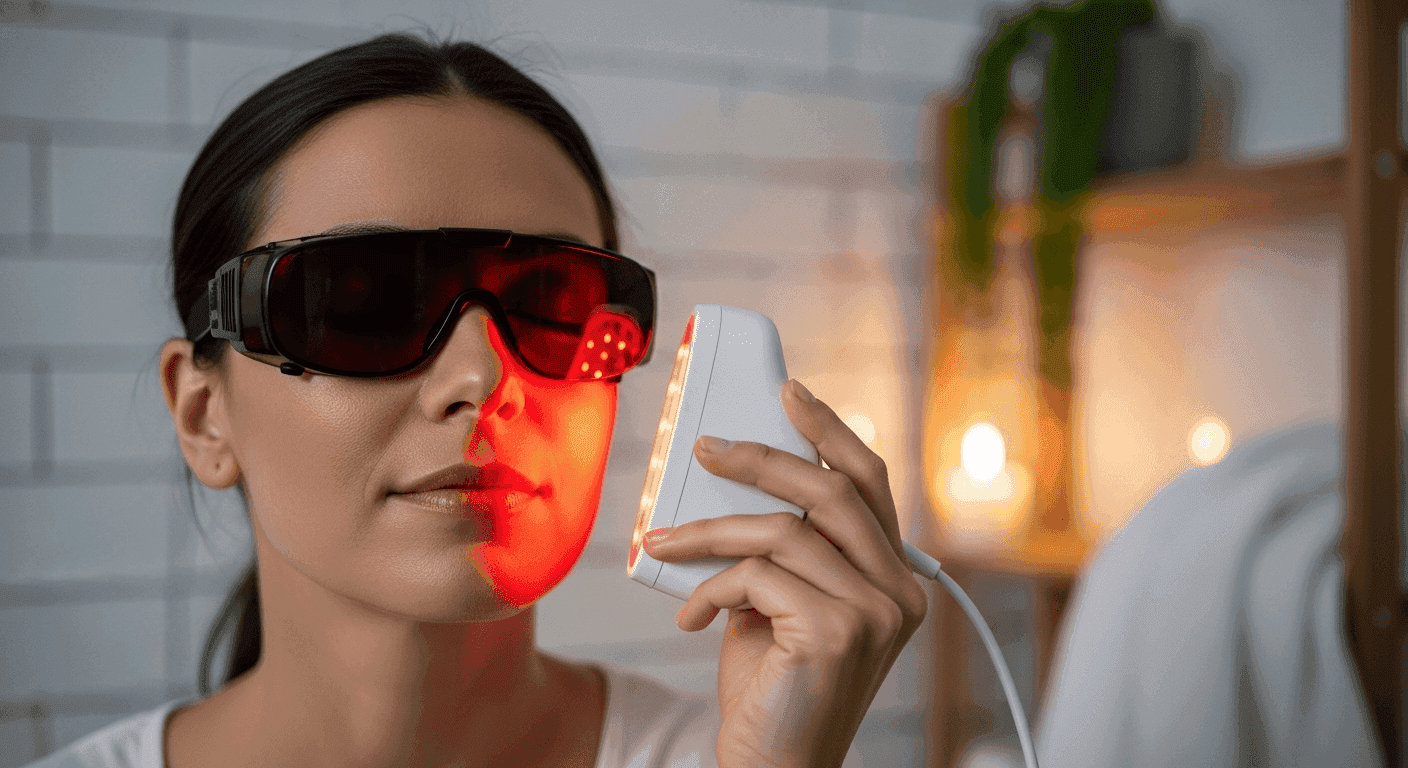
- Wear the goggles supplied with the panel. They are designed to block therapeutic wavelengths while staying comfortable.
- Closing your eyes is not enough. Eyelids transmit enough red and near-infrared light to reach the retina.
- For facial treatment, position the panel slightly above or to the side rather than aimed straight at closed eyes.
- Do not look directly into a panel at close range, and do not let curious kids do it either.
Near-infrared light (for example 850nm) is completely invisible, which removes the natural aversion response that makes you squint away from bright light, so a NIR panel can be delivering a real dose to the eye while looking "off." Anyone treating below the neck faces little eye risk, but any panel near eye level calls for protection.
Contraindications: Who Should Not Use Red Light Therapy
Most contraindications for LED and laser light therapy are precautionary: safety has not been proven in that group. That distinction matters, so the table grades how much real evidence sits behind each one. An EvidenceBadge reflects the strength of support for the concern, not the strength of the therapy.
| Condition | Concern | Recommendation |
|---|---|---|
| Active cancer / melanoma in the treatment field | PBM stimulates cellular metabolism and proliferation, which could in theory feed a tumor. No human evidence confirms this, but the concern is taken seriously. Theoretical, no human confirmation | Do not treat over a known active lesion. Anyone with a cancer history should clear treatment of the affected area with their oncologist. |
| Photosensitizing medications (isotretinoin, doxycycline, minocycline, amiodarone, some chemotherapy, psoralens, St. John's Wort) | These drugs increase skin and sometimes retinal sensitivity to light. Most data concern UV and sunlight, with visible-light reactions less established. Photosensitivity documented (mostly UV/sun) | Check with the prescriber before starting. Risk varies widely by drug and dose. |
| Pregnancy (over the abdomen) | No controlled data establish safety of PBM during pregnancy. This is an absence of evidence, not evidence of harm. Insufficient data | Avoid treating over the abdomen. Discuss any use with an obstetrician. |
| Photosensitive skin conditions (lupus/SLE, porphyria, xeroderma pigmentosum) | Heightened sensitivity to light, including some visible wavelengths, can provoke skin reactions. Established photosensitivity | Get dermatologist sign-off before treating affected skin. |
| Photosensitive epilepsy | Flickering or pulsed light can trigger seizures in susceptible people. Most panels run in continuous mode; some offer pulse settings. Flicker triggers documented | Use continuous mode only; avoid pulsed/flicker settings. |
| Over the thyroid (anterior neck) | Some protocols exclude the thyroid over a theoretical stimulatory effect. Evidence here is weak and largely speculative rather than demonstrated. Theoretical, weak evidence | If unsure, keep high-dose treatment off the front of the neck and ask your doctor. |
| Direct eye exposure (everyone) | The retina absorbs red/NIR strongly and cannot feel the damage as it happens. Established retinal-exposure hazard | Wear the supplied goggles; never stare into the panel. |
The thyroid line deserves an honest footnote, because it circulates online as if it were settled. It is not. The caution rests on the general idea that light might modulate an active endocrine gland, not on trials showing thyroid harm from red light therapy. If you have thyroid disease, the reasonable move is a conversation with your doctor, not alarm.
Medication and Photosensitivity Interactions
Photosensitizing drugs are the interaction most worth flagging, because they change how skin (and occasionally the retina) responds to light. Anyone on one of these should talk to the prescribing physician before using red light therapy:
- Tetracycline antibiotics (doxycycline, minocycline): increase UV and visible-light sensitivity.
- Fluoroquinolone antibiotics (ciprofloxacin): photosensitizing potential.
- Amiodarone: a cardiac drug with a pronounced photosensitivity profile.
- Isotretinoin and topical retinoids (tretinoin, adapalene): raise photosensitivity; use caution treating skin currently on retinoid therapy.
- Certain chemotherapy agents: several mechanisms of photosensitization.
- Psoralens: used in PUVA therapy and deliberately photosensitizing; do not layer additional phototherapy on top.
- St. John's Wort: an herbal supplement with documented photosensitizing effects.
- Thiazide diuretics: mild photosensitizing potential.
The list is not exhaustive, and most of the underlying data concern sunlight and UV rather than the specific red and near-infrared bands used therapeutically. That is a reason for a quick check with your prescriber, not a reason to assume a reaction. If you are on any regular medication and have doubts, ask.
Pregnancy and Specific Conditions
Pregnancy. Beyond the table's advice to avoid the abdomen, localized treatment far from the abdomen (for example a hand or foot) is a different risk picture, though the same "ask first" rule applies while data are thin.
Active cancer. The worry is theoretical but taken seriously enough to avoid. What the table cannot show is the nuance: the oncology systematic review above found PBM safe when used as a supportive therapy under clinical parameters (for oral mucositis in cancer patients, for instance), so the concern is about treating over a tumor, not a blanket ban for anyone who has ever had cancer. Clear it with an oncologist.
Photosensitive skin disease and epilepsy. Lupus, porphyria, and related conditions involve heightened light sensitivity and warrant a dermatologist's input before treating affected skin. For photosensitive epilepsy, the trigger is flicker: continuous-output panels are generally considered low-risk, but pulsed and flicker modes should be avoided.
What Doesn't Appear in the Contraindication Lists
Some widely repeated worries have no clinical basis, and it is worth clearing them.
Metal implants, pacemakers, pins and plates. Red and near-infrared light does not interact with metal implants. Joint replacements, surgical hardware, and internal metal do not absorb or concentrate these wavelengths. This is a frequent question with no evidence behind the concern.
Age. Nothing suggests red light therapy is less safe in older adults. The mechanisms work at all ages, and the elderly are well represented in positive trials for pain and skin.
Dark skin tones. Melanin absorbs some wavelengths, which in theory reduces penetration in darker skin. The trial evidence includes diverse populations and the therapeutic window appears sufficient across skin tones. There is no evidence of differential risk; if anything the question is about dose efficiency, not safety.
Can More Become Harmful? Overdosing and the Biphasic Response
The Arndt-Schulz curve in photobiology describes a dose response where low doses do little, moderate doses help, and high doses inhibit. It is well documented in cell-culture and animal work. In practice this is less a safety hazard than a reason not to overdo it.
At consumer irradiances (roughly 50–150 mW/cm²), reaching the inhibitory range takes unusually long exposure, typically well over 40 minutes at maximum irradiance. Normal 10–20 minute sessions do not get close. But standing in front of a panel for two hours on the theory that "more is better" can be counterproductive, and the fatigue or unwellness some people report from marathon sessions fits this pattern. The effective dose is a window, not a ladder. Our dosing guide covers how to land inside it.
Summary: How Safe Is Red Light Therapy?
Used correctly with eye protection, red light therapy has a favorable safety profile supported by thousands of trials and no serious adverse events in the systematic reviews. The risks that genuinely warrant attention are:
- Retinal damage from unprotected direct eye exposure: the one real hazard.
- Active cancer at or near the treatment site: a theoretical but serious concern; avoid and consult an oncologist.
- Photosensitizing medications: check with the prescriber.
- Pregnancy: insufficient data; avoid the abdomen and ask an obstetrician.
For the large majority of healthy adults treating skin aging, pain, and recovery, the risk is low and the adverse-event history in the literature is clean. None of that removes the value of a physician's input for anyone with a complex medical history. If you want the fundamentals first, start with what red light therapy is; if you are choosing hardware, our best red light therapy devices guide screens on evidence, and our methodology explains how we grade it.
LightTherapyIQ covers the clinical evidence on light therapy devices. No manufacturer pays for editorial coverage.
Frequently Asked Questions
Is red light therapy dangerous?
For healthy adults using consumer devices at normal doses, red light therapy is low-risk. Across thousands of clinical trials, adverse events are rare and mild — transient redness, mild warmth, occasional headache. The one genuine hazard is unprotected direct eye exposure, which can cause cumulative retinal damage. Specific groups (people on photosensitizing drugs, those with active cancer in the treatment area, and pregnant users treating the abdomen) should get medical advice first.
What are the contraindications for LED light therapy?
The most consistently listed contraindications are active cancer at or near the treatment site, use of photosensitizing medications (isotretinoin, doxycycline, amiodarone and others), pregnancy (over the abdomen), photosensitive skin conditions like lupus or porphyria, and photosensitive epilepsy when using pulsed or flickering modes. Direct, unprotected eye exposure is a hazard for everyone. Most of these are precautionary rather than proven harms.
Can red light therapy make you feel sick or nauseous?
There is no established mechanism by which topical red or near-infrared light causes nausea. When people feel unwell during or after a session, the likely causes are overheating from a high-power panel at close range, dehydration, eye strain from looking at the light, or simply doing very long back-to-back sessions. Shortening the session, adding distance, hydrating, and protecting the eyes usually resolves it.
Can red light therapy be harmful?
It can be harmful in specific situations: staring into a panel without eye protection risks retinal damage; treating over an active tumor is a theoretical concern serious enough to avoid; and people on strong photosensitizing drugs can react. Used correctly by a healthy adult, harm is unlikely — the clinical literature reports no serious adverse events attributable to therapeutic light at recommended doses.
Are there side effects of red light therapy?
Yes, but they are typically minor and temporary: mild redness (erythema) at the treatment site, a feeling of warmth, occasional headache when treating near the head, and rarely a short-term flare of symptoms in the first few sessions. These resolve on their own. Serious side effects are not reported in systematic reviews of correctly administered treatment.
Is red light therapy safe for your eyes?
Body treatment below the neck poses little eye risk. But looking directly into a high-intensity panel — or treating the face without protection — exposes the retina to red and near-infrared light it absorbs strongly. The retina has no pain sensors, so damage is painless and can be permanent. Wear the goggles supplied with the device; closing your eyes is not enough because eyelids transmit these wavelengths.