HigherDOSE Sauna Blanket: What the Evidence Actually Supports
A measured look at the HigherDOSE Infrared Sauna Blanket: where far-infrared heat has study support, and where crystal, magnet, detox, and low-EMF claims outrun the data.
By LightTherapyIQ Editorial Team, Editorial
On this page
What the blanket is, and what it is not
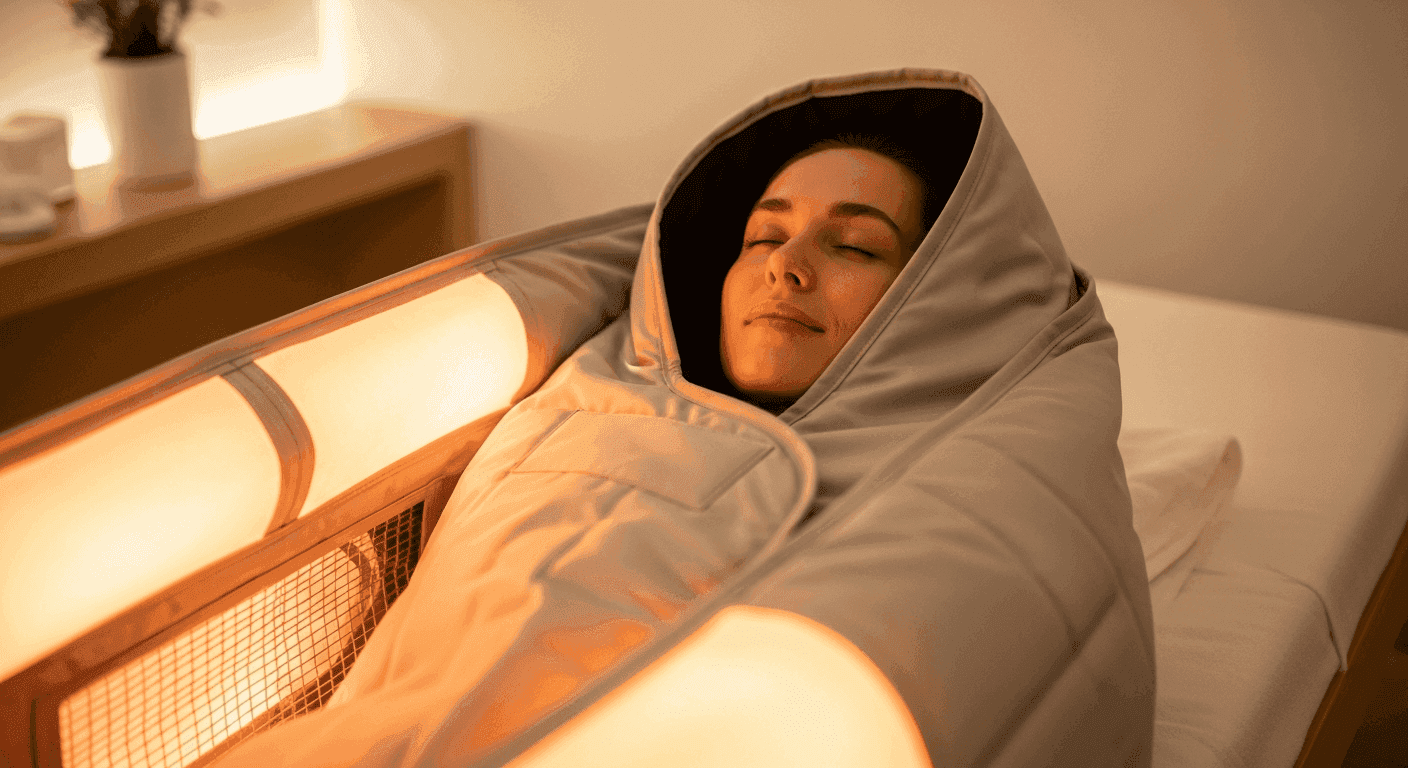
The HigherDOSE Infrared Sauna Blanket is a $699 cocoon-style blanket that wraps around your body and delivers far-infrared heat, with a stated maximum temperature of 175°F. You lie inside it the way you would lie in a sleeping bag, and infrared panels in the lining warm you from the outside in. It is one of the most visible sauna blankets on the market, carried by a wave of celebrity endorsement and wellness marketing.
The marketing stacks several different kinds of claims on top of each other. The blanket will make you sweat, and that sweat is presented as detox. The lining includes crystal and magnetic layers, which are said to add unspecified benefits. The product is described as low-EMF. And customer survey percentages are quoted the way a drug company might quote trial results. Each of those claims deserves its own verdict, because they are not equally supported.
Weak evidence: no product-specific trialsThis article works through the evidence layer by layer: the part that has genuine study support (heat exposure), the parts that do not (crystals, magnets, detox, and a low-EMF label without a number), and the parts where marketing borrows the authority of science without its substance (surveys presented as results). For a broader tour of the sauna literature, see our overview of infrared sauna benefits.
The part with evidence: heat exposure
Strip away everything else and the blanket is a device for whole-body heat exposure. Far-infrared radiation heats tissue, your core temperature rises, you sweat, your heart rate climbs, and your blood vessels dilate. That is the same family of physiological stress as a Finnish sauna, a hot bath, or any other passive heating. The mechanism is heat, not light photochemistry: far-infrared wavelengths do not penetrate more than a few millimeters into skin, so the deep effects come from the heat itself circulating through the body, not from the infrared reaching deep tissue directly.
There is a real, if limited, research literature on heat exposure and infrared saunas. Three studies are worth knowing because they cover the three kinds of claims a sauna blanket buyer will encounter: pain relief, cardiovascular associations, and short-term symptom improvement.
| Study | N | Protocol | Finding |
|---|---|---|---|
| Oosterveld et al., 2009 (Clin Rheumatol) | 34 (17 RA + 17 AS) | Eight infrared sauna sessions over 4 weeks; uncontrolled pilot study | Pain and stiffness improved during sessions (p < 0.05 in RA, p < 0.001 in AS); fatigue decreased; no disease exacerbation; longer-term period effects did not reach statistical significance |
| Matsushita et al., 2008 (Intern Med) | 13 | Far infrared-ray dry sauna at 60°C for 15 min followed by 30 min warming under a blanket, 2-5x/week (Waon therapy) | Pain VAS and fibromyalgia impact scores fell significantly (p < 0.01) and stayed low; tiny sample, no control group |
| Laukkanen et al., 2015 (JAMA Intern Med) | 2315 | Prospective cohort of Finnish men; sauna frequency and session length self-reported at baseline; median 20.7 years follow-up | More frequent and longer sauna sessions associated with lower risk of sudden cardiac death, fatal CHD, CVD, and all-cause mortality; observational, traditional Finnish sauna, not infrared |
Reading the evidence table honestly
Each of these studies says something genuine and something limited.
The Oosterveld pilot is the closest match to what a sauna blanket does: actual infrared sauna sessions in people with rheumatoid arthritis and ankylosing spondylitis. Participants tolerated the heat well, and pain and stiffness eased during sessions. But it was a pilot with 34 people and no control group, so the improvements cannot be separated from placebo response, regression to the mean, or simply resting in a warm room. The longer-term improvements over the four weeks did not reach statistical significance. It is a signal worth following up, not a finding to build a purchase on.
The Matsushita Waon therapy study is the closest match to a blanket-shaped experience: far-infrared heat followed by wrapping in a blanket to stay warm. Pain scores in 13 fibromyalgia patients dropped substantially. But thirteen people with no control group is a case series, and fibromyalgia pain fluctuates. It supports the idea that sustained heat can be soothing. It does not show that a home sauna blanket produces these results.
The Laukkanen cohort study is the most impressive on its face: 2,315 men followed for over 20 years, with frequent sauna use associated with lower cardiovascular and all-cause mortality. It is also the least transferable. It studied traditional Finnish saunas, not infrared blankets. It was observational, so the men who used saunas four to seven times a week may have differed from occasional users in many other ways. Association is not causation, and no one should buy a blanket expecting to change their mortality risk.
And crucially, none of these studies tested the HigherDOSE blanket. No published clinical trial has evaluated this product or, to our knowledge, any consumer sauna blanket. Everything the product page implies about outcomes is extrapolated from general heat research, from other devices, or from customer impressions.
The extras: crystals, magnets, and detox
With heat established as the real mechanism, what remains is the set of claims layered on top of it.
Crystals and magnets. The blanket's marketing describes crystal and magnetic layers in the lining. There are no published clinical trials showing that crystals or static magnets embedded in a blanket lining produce any physiological effect, and there is no proposed mechanism by which they would. This is decoration with a wellness narrative attached, and it should be weighed accordingly: it costs you nothing in the heat department, but it should carry no weight in your decision.
Detox. Sweating does excrete trace amounts of some substances, including certain metals and metabolic waste products. What it does not do, in any meaningful quantity, is "detoxify" the body in the way marketing implies. Detoxification is performed by the liver and kidneys, continuously, whether or not you are sweating in a blanket. Studies of sweat composition show that the amounts of heavy metals excreted through sweat are small relative to what the body clears through urine and feces. Feeling cleansed after a sweat session is a real sensation; it is not evidence of toxin removal, and no study has shown that sauna-blanket sweating removes clinically meaningful amounts of toxins.
Heat is the active ingredient. None of this takes away from the heat itself. If you use the blanket, the heat is doing the work: raising your core temperature, making you sweat, relaxing muscles, and providing the soothing warmth that the small pilot studies associate with short-term symptom relief. The extras are along for the ride.
The low-EMF claim without a number
The product is marketed as low-EMF, which sounds reassuring next to a device that plugs into the wall and wraps around your body. But the brand does not publish an EMF figure for the blanket. Our product data lists EMF as not published, and that absence matters: "low" is a comparison, and a comparison needs a number, a measurement distance, and a stated method. Without those, a low-EMF label cannot be checked, cannot be compared to competing products, and cannot be treated as evidence of anything.
This is a pattern worth recognizing across the category. Some sauna brands publish milligauss readings at a stated distance with a stated meter; others use the words "low EMF" as a marketing phrase. Only the first kind is information. If EMF exposure is a deciding factor for you, ask the brand for a number measured at body distance, and treat the absence of one as the answer.
Marketing surveys are not clinical trials
Sauna blanket marketing, including HigherDOSE's, leans on customer survey percentages: large shares of users reporting that they feel more relaxed, sleep better, or notice their skin looks better. These numbers are sometimes presented with the visual grammar of science: percentages, sample sizes, confident claims.
A customer survey is not a clinical trial, and the difference is not a technicality. Survey respondents chose to buy the product, paid for it, and are reporting subjective impressions with no control group, no blinding, and no accounting for the fact that people who feel nothing are less likely to answer. The placebo response to a $699 purchase used in a relaxing ritual is substantial. None of this means users are lying about feeling better. It means the numbers cannot tell you whether the blanket caused the improvement, how large the improvement was, or whether a warm bath would have done the same. Treat survey percentages as marketing, however precisely they are stated.
Practical use and safety
If you buy a sauna blanket for the heat, use it like heat: start with shorter sessions at lower temperatures, hydrate before and after, and give your body time to cool down afterward. Do not use it while intoxicated or while taking medications that impair heat tolerance or sweating unless a clinician has cleared it. People who are pregnant, have cardiovascular disease or uncontrolled blood pressure, or have conditions affecting heat tolerance should talk to a clinician before using any whole-body heating product. Stop and cool down if you feel dizzy, nauseated, or unwell. These are the standard precautions for saunas generally, and they apply to blankets too, since the physiological stress is the same kind.
On value: $699 buys you convenient, private heat exposure without a sauna room or a gym membership. It does not buy you clinical outcomes, detoxification, or the benefits implied by the crystal, magnet, and survey claims. Whether that trade is worth it depends on how much you value having heat on demand at home versus a hot bath, a gym sauna, or simply a warm room. Price buys convenience and consistency here, not efficacy.
The bottom line
The HigherDOSE Infrared Sauna Blanket is a plausible way to get regular whole-body heat exposure at home, and heat exposure has modest, limited study support for short-term comfort and relaxation. What it is not is a clinically tested device, and the crystal, magnet, detox, and low-EMF claims layered around the heat have no meaningful evidence behind them. Buy the heat if you want the heat. Discount everything else to zero, and do not let survey percentages stand in for trials that were never run.
Frequently Asked Questions
Has the HigherDOSE sauna blanket been clinically tested?
No published clinical trial has evaluated the HigherDOSE blanket specifically. The relevant evidence covers heat exposure and infrared saunas in general, from small pilots to one large observational cohort, and none of it tested this product.
Does an infrared sauna blanket detox your body?
Sweating excretes only trace amounts of waste substances. The liver and kidneys perform the body's detoxification continuously. No study has shown that sauna-blanket sweating removes clinically meaningful amounts of toxins.
What does low-EMF mean for a sauna blanket?
Without a published milligauss figure, a measurement distance, and a stated method, low-EMF is a marketing phrase rather than a specification. HigherDOSE does not publish an EMF number for the blanket, so the claim cannot be verified or compared.
Is a sauna blanket the same as a Finnish sauna for health purposes?
Both deliver whole-body heat, which is the studied mechanism. But the large cohort studies on sauna and mortality examined traditional Finnish saunas, not infrared blankets, and observational findings cannot be assumed to transfer across devices.