Best LED Face Masks (2026): What the Clearances and Measurements Actually Show
We cross-checked FDA 510(k) clearances and independent irradiance measurements for the leading red light therapy masks. Four earn a recommendation, one badly overclaims its output.
By LightTherapyIQ Editorial Team, Editorial
Our picks
We may earn a commission when you buy through links on this page. It does not change the order of our picks. How we evaluate devices
Omnilux Contour Face
Best overall$350-400FDA-cleared (K191629)
Jump to the details: Omnilux Contour FaceCheck priceCurrentBody Series 2
Best premium$450-500FDA-cleared (K250966)
Jump to the details: CurrentBody Series 2Check priceSolawave Radiant Renewal Wand
Best budget$150-200FDA-cleared (K232863)
Jump to the details: Solawave Radiant Renewal WandCheck price
When to pick differently. The Omnilux has no blue light channel, so it treats wrinkles and texture only. If your main concern is inflammatory acne, choose a mask with blue light, such as the Shark CryoGlow.
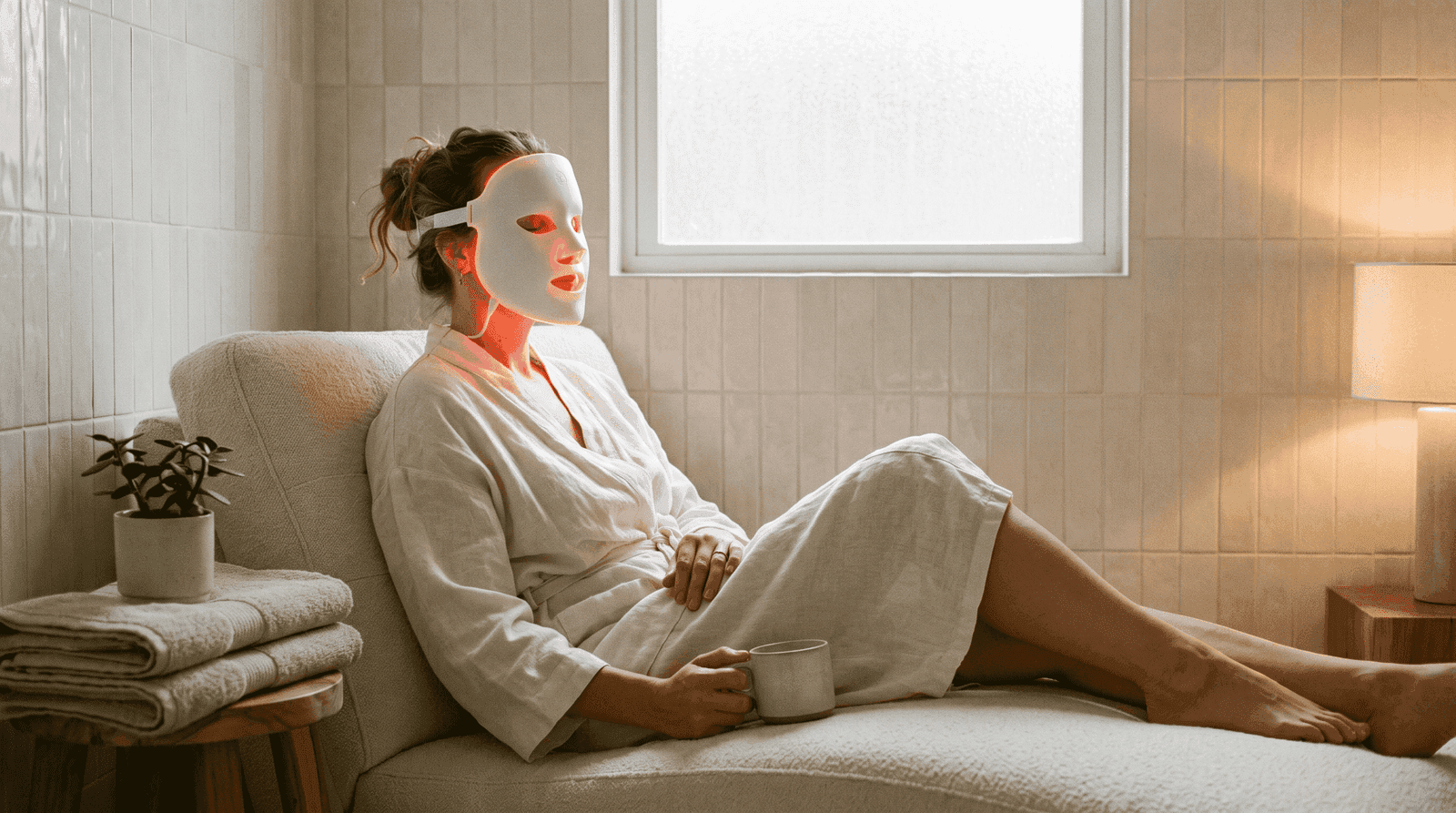
If you want the short version: buy a mask that holds a real FDA clearance for the outcome you care about, and check that its light output has been measured by someone who does not sell it. On those two tests, the Omnilux Contour Face is the pick for most people. The CurrentBody Series 2 is the upgrade if you want more coverage and a near-infrared channel. The Solawave Radiant Renewal Wand is the cheapest cleared entry point. The Shark CryoGlow is the one to get if you also fight inflammatory acne. One popular mask, the Qure Q-Rejuvalight Pro, fails the second test badly enough that we cannot recommend it, and we explain why below.
LED face masks occupy an unusual spot in the light therapy market. Unlike the full-body panels we cover, several masks have gone through the FDA's 510(k) premarket notification process and carry genuine clearances for wrinkle reduction. That is a meaningfully higher bar than the "FDA-registered facility" language panel brands lean on. Clearance still says nothing about whether a given unit delivers a therapeutic dose, so this guide checks both: the paperwork and the photons.
How We Picked
We do not run a hands-on light lab. We are honest about that. What we do is cross-reference three independent sources for every mask: the manufacturer's specification, the FDA 510(k) database for the actual clearance and K-number, and independent spectrometer measurements from reviewers who publish their methodology, primarily the spectroradiometer testing at Light Therapy Insiders. Where those three disagree, the measurement wins over the marketing, and we say so on the page. Our full process is documented at /methodology.
Three filters decided the list:
A verifiable FDA clearance. Every recommended mask has a specific 510(k) K-number under product code OHS (over-the-counter powered light-based wrinkle treatment) or a comparable clearance we could confirm in the FDA database. We link each one so you can read the record yourself. Registration of a manufacturing facility does not count and never appears here as "FDA cleared."
Measured irradiance in the effective range. The controlled trials on facial photorejuvenation delivered roughly 4 to 60 J/cm² per session. A mask sitting against the skin needs about 18 to 30 mW/cm² over a 3 to 10 minute session to land in that window. We prioritized masks whose independently measured output clears that bar and flagged the ones that do not.
Wavelengths matched to a real mechanism. Red at 630–660nm and near-infrared at 830nm for collagen; blue at 415nm for acne bacteria. A mask advertising a wavelength it does not actually emit is a disqualifier, which is why the spec-sheet errors we found matter.
Overall evidence for LED facial photorejuvenation: multiple randomized controlled trials, modest effect sizes, consistent directionThe Wavelength and Dose Reality for Facial Skin
Red light works on skin because 630–660nm penetrates 1–2mm into the dermis, where fibroblasts manufacture collagen. At those wavelengths, light activates cytochrome c oxidase, ATP output rises, procollagen type I synthesis increases, and MMP-1 (the enzyme that degrades existing collagen) is downregulated. Near-infrared at 830nm reaches slightly deeper and supports the same pathway. We cover the cellular mechanism in depth in red light therapy for skin.
Here is the part the marketing skips. Masks deliver far less irradiance than the panels used in most published trials, and that is fine, because of geometry. A panel is tested at 6 inches from the skin, where its beam has spread and weakened. A mask sits directly against your face. The inverse-square falloff that costs a panel most of its output does not apply, so a mask measuring 20 mW/cm² at contact can deliver a per-session dose comparable to a panel reading 50–80 mW/cm² at 6 inches. Over a 10-minute session, 20 mW/cm² at contact works out to about 12 J/cm², which sits inside the range the positive trials used.
That is why the specific number matters more than it looks. The masks we recommend measure between 18 and 30 mW/cm². The failure case is not a mask that reads lower than a panel. It is a mask that reads 8 mW/cm² when it claims 70, because at 8 mW/cm² a 3-minute session delivers roughly 1.5 J/cm², below the threshold where the biology responds. Dose is the whole game, and dose is claimed irradiance times honesty.
The face-specific case for a mask over a panel comes down to two things: contact geometry and compliance. A panel gives you more total power and covers the body, but treating your face with one means sitting still at a measured distance for the full session, and most people do that inconsistently. A mask you strap on and forget delivers its dose to every contour at once, including the sides of the nose and the under-eye area a flat panel underexposes. For facial skin as the only target, the mask is the device people actually keep using, and adherence over 12 weeks is what produces the trial-level results. If you already own a strong panel for whole-body use, you do not need a mask on top of it. If your goal is the face and nothing else, the mask is the better-matched tool.
Best Overall: Omnilux Contour Face
Contour Face
Omnilux / mask
$350-400
- Wavelengths
- 633nm / 830nm
- Measured
- ~28 mW/cm² independently measured (Alex Fergus / lighttherapyinsiders-linked comparison content referenced via redl...
- Value
- Coverage not comparable
Omnilux is the mask brand with the deepest clinical footprint, and the Contour Face is its flexible full-face home unit. It runs two wavelengths, 633nm red and 830nm near-infrared, across 132 LEDs, which is the exact red-plus-NIR pairing that carries the most photorejuvenation evidence. It is cleared as a Class II over-the-counter wrinkle-reduction device; the clearance traces to K191629 in the faceLITE/I-Smart lineage under the same manufacturer and product code. We treat that link as high-confidence rather than manufacturer-confirmed, and we would rather tell you that than pretend the record is cleaner than it is.
What earns it the top spot is that its numbers hold up. Omnilux states about 30 mW/cm² of output, and independent measurement puts it near 28 mW/cm², the smallest claimed-versus-measured gap of any mask here. A 10-minute session lands squarely in the effective dose range. The flexible silicone form contours to the face rather than sitting rigid, and the mid-$300s price band undercuts the premium tier while clearing the same evidentiary bar. For someone whose goal is fine lines and texture, this is the most defensible purchase in the category.
The limit worth naming: two wavelengths only, no blue channel, so it is a wrinkle-and-texture tool, not an acne device.
Best Premium: CurrentBody Series 2
CurrentBody Skin LED Light Therapy Mask: Series 2
CurrentBody / mask
$450-500
- Wavelengths
- 633nm / 830nm / 1072nm
- Measured
- 18.5 mW/cm² average, spectrometer-measured, 11.2 J/cm² fluence over a 10-minute session ()
- Value
- Coverage not comparable
The CurrentBody Series 2 is the coverage-and-features upgrade. It carries 236 LEDs across three wavelengths, adding 1072nm to the 633nm and 830nm pairing, and its clearance is both recent and clean: K250966, cleared June 2025 under product code OHS, verified directly in the FDA database. The flexible "Best-Fit" silicone gives the most even skin contact of the masks here, which matters for delivering a consistent dose across the whole face rather than just the high points.
One honest mark against it. CurrentBody cites roughly 30 mW/cm², but spectrometer testing measured 18.5 mW/cm² average, an 11.2 J/cm² fluence over a 10-minute session. That is the largest claim-to-measurement gap among our recommended masks. It still clears the effective threshold, so the mask works, but you are paying the top price band (high-$400s) for output that reads lower than the Omnilux at nearly the same session length. You buy the Series 2 for the fit, the third wavelength, and the coverage, not for raw intensity per LED.
Best Budget: Solawave Radiant Renewal Wand
Radiant Renewal Skincare Wand with Red Light Therapy (formerly "Advanced/4-in-1 Skincare Wand")
Solawave / handheld
$150-200
- Wavelengths
- 630nm
- Measured
- -
- Value
- Coverage not comparable
Not everyone wants to spend into the $300s to try red light on their face. The Solawave Radiant Renewal Wand is the cheapest cleared entry point, in the $150–200 band, and it holds a real clearance: K232863, a Class II OTC wrinkle-reduction device verified in the FDA database.
Set expectations correctly. This is a 14-LED handheld wand at 630nm, not a full-face mask, so it treats one small area at a time. You glide it over the face and neck for about 3 minutes per zone, roughly 12 minutes total, and it bundles galvanic current, warmth, and massage alongside the light. The multi-function design means the light output is not independently measured, and the small emitter covers a fraction of what a mask does per session. It is the right pick for a curious first-time buyer or someone targeting specific spots rather than the whole face. Solawave as a brand has drawn consumer-litigation interest over advertising claims across its product line, which is worth knowing before you buy, though it is not a confirmed finding against this device.
Best Multi-Wavelength: Shark CryoGlow
CryoGlow LED Face Mask
Shark (SharkNinja) / mask
$300-350
- Wavelengths
- 415nm / 630nm / 830nm
- Measured
- -
- Value
- Coverage not comparable
If your skin concern is acne as much as aging, the Shark CryoGlow is the pick, because its clearance actually covers both. It is cleared under K242796 (product code OHS, SharkNinja, November 2024) as safe and effective for fine lines and for mild-to-moderate inflammatory acne. That acne clearance is a genuine differentiator over the wrinkle-only clearances on the Omnilux and CurrentBody. It runs three channels: 415nm blue for acne bacteria, 630nm red, and 830nm near-infrared, plus an under-eye cooling feature.
A spec caveat you should know before you shop. SharkNinja's own product page lists the blue channel as "Blue 630nm," which is a copy error, since 630nm is red. An independent LED-device designer measured the blue channel at 415nm, the clinical standard for acne, and that is the number we trust. The wavelength the device emits is correct; the wavelength on the box is mislabeled. We flag it so you are not confused when the spec sheet contradicts itself. Independent irradiance for the CryoGlow has not been published, so treat its output as unverified even though the clearance and wavelengths check out. For acne specifically, also read our evidence review on blue light therapy for acne.
Compare the Cleared Masks
| Feature | Contour Face | CurrentBody Skin LED Light Therapy Mask: Series 2 | CryoGlow LED Face Mask | Radiant Renewal Skincare Wand with Red Light Therapy (formerly "Advanced/4-in-1 Skincare Wand") |
|---|---|---|---|---|
| Wavelengths | 633nm / 830nm | 633nm / 830nm / 1072nm | 415nm / 630nm / 830nm | 630nm |
| Claimed irradiance | ~30 mW/cm² (manufacturer-stated energy output; distance/measurement conditions not specified) | ~30 mW/cm² (manufacturer/brand-cited figure; distance/conditions not specified on product page) | - | - |
| Measured irradiance | ~28 mW/cm² independently measured (Alex Fergus / lighttherapyinsiders-linked comparison content referenced via redl... | 18.5 mW/cm² average, spectrometer-measured, 11.2 J/cm² fluence over a 10-minute session () | - | - |
| Coverage | full face | full face ("Best-Fit" flexible liquid silicone) | full face, with integrated under-eye cooling (InstaChill) | spot/wand treatment — face and neck, rotating head, ~3 min per area / ~12 min total daily |
| Price band | $350-400 | $450-500 | $300-350 | $150-200 |
| FDA status | FDA-cleared (K191629) | FDA-cleared (K250966) | FDA-cleared (K242796) | FDA-cleared (K232863) |
| Price/cm2 | - | - | - | - |
| Check Price | Check Price | Check Price | Check Price |
The Claimed-Versus-Measured Problem
The single most useful skill when buying any light therapy device is reading the gap between what a brand claims and what a spectrometer finds. Across this category the gap is the rule, not the exception, and its size is what separates a working mask from a prop.
The clearest failure is the Qure Q-Rejuvalight Pro. It holds a legitimate clearance, K230042, and markets itself as the first FDA-cleared customizable LED mask for wrinkles and mild-to-moderate acne. The problem is output. Qure claims 70 mW/cm². Independent spectrometer testing measured 5 to 11 mW/cm², averaging about 8, roughly 8 to 9 times below the claim, with some of the loss attributed to the silicone cover absorbing light. At 8 mW/cm², a 3-minute session delivers about 1.5 J/cm², under the 5 to 9 J/cm² commonly cited as an effective facial dose. A clearance certifies that a device is substantially equivalent to a predicate and safe for OTC use. It does not certify that the device delivers the dose its marketing promises. The Qure is the case study for why the clearance and the measurement are two separate questions, and reviewers also report unit failures around 12 to 14 months, just past its 1-year warranty.
Our recommended masks are not immune to the pattern. The CurrentBody Series 2 measures 18.5 mW/cm² against a ~30 claim. The Omnilux measures ~28 against ~30. The difference is degree: a 40 percent shortfall that still clears the effective threshold is a different situation from an 8-fold shortfall that drops below it. Buy on measured output where it exists, and treat any unmeasured claim as a marketing figure until someone independent checks it.
What the Clinical Evidence Actually Says
The evidence for LED photorejuvenation is real, replicated, and modest in effect size. It is worth reading the actual trials rather than the phrase "clinically proven" on a box.
| Study | N | Protocol | Finding |
|---|---|---|---|
| 136 volunteers | Randomized controlled trial; polychromatic red/NIR, twice weekly, 30 sessions | Significant improvement in skin roughness and wrinkle depth; ultrasound-measured intradermal collagen density increased versus untreated controls | |
| 76 patients | Randomized, placebo-controlled, double-blind, split-face; 830nm, 633nm, or both | Wrinkles reduced up to 36% and skin elasticity increased up to 19%; histology showed increased collagen and elastic fibers | |
| In vitro model + split-face single-blinded | Pulsed 660nm LED; reconstructed skin biochemistry plus clinical assessment over 12 treatments | Type-1 procollagen up ~31% and MMP-1 down ~18% in tissue; >90% of subjects showed reduced wrinkle depth and roughness | |
| 107 patients | Controlled trial of blue (415nm) + red (660nm) light versus alternatives, 12 weeks | Mean 76% improvement in inflammatory acne lesions, outperforming blue-alone, benzoyl peroxide, and white light |
Two things stand out across this body of work. First, every positive result runs on a weeks-to-months clock. Wunsch used 30 sessions; Lee, Barolet, and Papageorgiou all measured outcomes at or beyond 12 weeks. Second, the effect sizes are meaningful but bounded: a 36 percent wrinkle reduction and a 19 percent elasticity gain are worth having, and they are not a facelift. The direction is consistent enough, across independent research groups and objective measurement tools, that the mechanism is not in doubt. The magnitude is what marketing inflates.
Blue + red light for mild-to-moderate inflammatory acne: randomized controlled trial support (Papageorgiou 2000)Realistic Expectations
The people who are happy with an LED face mask a year later share one trait: they kept using it after the first month showed nothing. Collagen remodeling does not produce visible change in days, and a mask that promised otherwise set you up to quit early. In the trials, the needle moved at 8 to 12 weeks with sessions 3 to 5 times a week.
What a good mask delivers over that timeline is subtle: smoother texture, softer fine lines, a modest lift in firmness, and for acne-cleared masks, fewer inflammatory lesions. What it does not do is erase established deep wrinkles or replace a retinoid or in-office procedure for structural change. Results also depend on maintenance, because fibroblast stimulation is active during a treatment course and drifts back toward baseline when you stop. Frequency guidance is covered in how often you should use red light therapy. Treat a mask as a standing habit, roughly ten minutes most days, and judge it at week 12, not week 2.
A practical note on how a mask fits a routine. Use it on clean, dry, bare skin, since serums and creams can absorb or scatter light before it reaches the dermis, and a heavy occlusive layer works against you. Light therapy pairs well with the rest of an evidence-based regimen rather than replacing it: daily SPF still does more to prevent new photoaging than any device reverses, and a retinoid remains the stronger tool for structural collagen change. The mask is an additive layer that raises the baseline, not the centerpiece. One well-chosen, correctly dosed mask used consistently beats a drawer of gadgets used sporadically, so there is little reason to stack multiple facial devices.
Eye Safety
Every mask recommended here is an FDA Class II device cleared for over-the-counter home use, and the visible red and near-infrared wavelengths are non-ionizing and low-power, which puts facial LED masks at the safe end of light therapy. The sensible precautions are simple: keep your eyes closed during a session, and choose a mask with built-in eye shielding or cutouts, which all four of our picks provide. Blue light at 415nm carries slightly more retinal caution than red or near-infrared, so closed eyes matter a bit more on the Shark CryoGlow and other blue-channel masks. If you have a retinal condition, take photosensitizing medication, or have any history of light-triggered issues, clear it with a doctor before starting.
Who Should Skip This
An LED mask is a wellness tool for otherwise healthy skin, not a treatment for active disease. Skip it, or check with a dermatologist first, if any of the following apply.
You have an active skin condition such as rosacea flares, eczema, a suspicious or changing mole, or open lesions. Light therapy can aggravate some inflammatory conditions, and a professional should evaluate the skin before you add heat and light to it. Our overview of red light therapy side effects covers the contraindications in detail.
You take a photosensitizing medication (certain antibiotics, retinoids at prescription strength, some diuretics and psychiatric drugs) or have a photosensitivity disorder. These raise the chance of an adverse reaction to light exposure.
Your primary concern is moderate-to-severe or cystic acne. An LED mask, even a blue-channel one, is an adjunct at best for that. Prescription topicals and oral therapy have a stronger and faster evidence base, and a mask does not replace them. Our blue light therapy for acne review lays out where light fits alongside standard acne treatment.
For anyone outside those groups who wants a modest, evidence-backed improvement in fine lines, texture, or mild inflammatory acne, a cleared mask with verified output is a reasonable buy. Start with the Omnilux Contour Face, or browse the full set of devices we track at /devices.
LightTherapyIQ covers the clinical evidence on light therapy devices. No manufacturer pays for editorial coverage.
Frequently Asked Questions
Do LED face masks actually work?
For fine lines, skin texture, and inflammatory acne, the mechanism has controlled-trial support and several masks hold FDA 510(k) clearance for wrinkle reduction. The effect is real but modest, and it depends on the mask delivering enough light. Two masks marketed at 65–70 mW/cm² measured under 10 mW/cm² on a spectrometer, which is below the dose used in the positive trials. A cleared mask that delivers 18–30 mW/cm² at skin contact is a reasonable home tool; a mask that delivers 8 mW/cm² is mostly a light show.
How often should I use an LED face mask?
The clinical trials that produced measurable collagen and wrinkle changes ran sessions 3 to 5 times per week for 10 to 20 minutes, sustained over 8 to 12 weeks or longer. Most cleared masks program a 3 to 10 minute session because they sit against the skin at close range. Daily use is fine and matches how the devices are cleared. Doubling session length does not double results once you have hit the effective dose. Consistency across weeks matters more than any single session.
Red versus blue light for the face: which do I need?
Red (630–660nm) and near-infrared (830nm) target fibroblasts and collagen, so they address fine lines, texture, and photoaging. Blue (415nm) is antibacterial and targets the Cutibacterium acnes bacteria behind inflammatory acne. If your goal is anti-aging, a red plus near-infrared mask is the match. If you have active inflammatory acne, look for a mask cleared with a blue channel alongside red. Wrinkle-only clearances do not cover acne, and vice versa.
Are LED face masks safe for the eyes?
The cleared masks in this guide are FDA Class II devices tested for over-the-counter home use, and the visible red and near-infrared wavelengths are non-ionizing and low-power. The sensible precaution is to keep your eyes closed during sessions and use a mask with built-in eye shielding or cutouts, which every mask here has. Blue light at 415nm warrants a little more eye caution than red, so closed eyes matter more on masks with a blue channel. Anyone with a retinal condition or on photosensitizing medication should check with a doctor first.
How long until I see results?
Collagen synthesis and remodeling run on a weeks-to-months timeline. In the controlled trials, measurable changes in wrinkle depth and collagen density appeared at 8 to 12 weeks of consistent use, not days. Any mask promising a visible change in one week is selling against its own biology. Expect subtle improvement in texture and fine lines by week 12 with 3 to 5 sessions a week, and treat it as maintenance rather than a one-time fix.