Best Handheld Red Light Therapy Devices & Wands (2026): Spot Treatment, Honestly Graded
One handheld holds a real 510(k) (Solawave, K232863) and none has independent output data. Which wands earn a spot-treatment role, the session math, and when a panel or mask is the smarter buy.
By LightTherapyIQ Editorial Team, Editorial
Our picks
We may earn a commission when you buy through links on this page. It does not change the order of our picks. How we evaluate devices
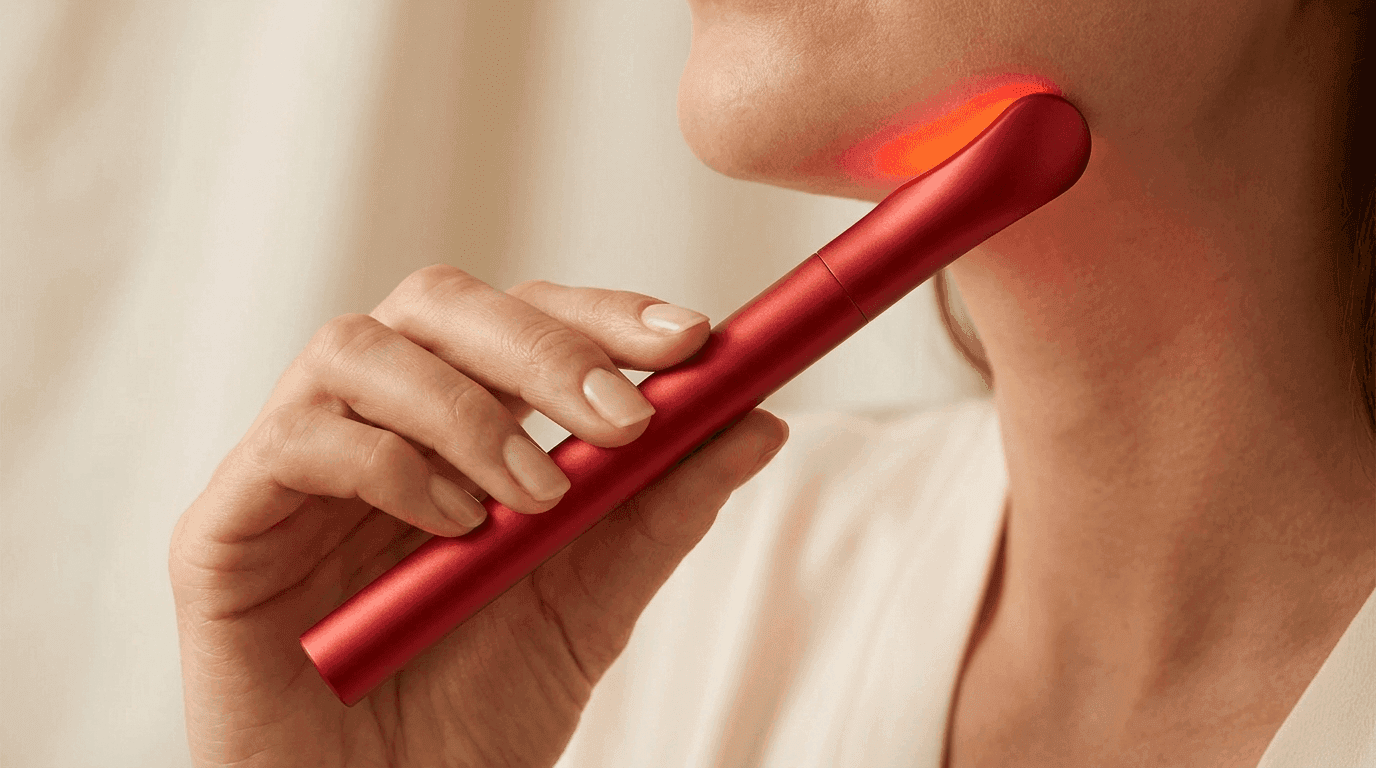
Solawave Radiant Renewal Wand
Best for skin$150-200FDA-cleared (K232863)
Jump to the details: Solawave Radiant Renewal WandCheck priceHooga HG24
Best for joints and muscleUnder $50No FDA clearance found
Jump to the details: Hooga HG24Check price
When to pick differently. These picks fit one small target. If you want to treat your whole face or more than one area, a mask or a panel does it faster than any handheld.
The Short Version
Two picks cover this whole category. For facial skin, buy the Solawave Radiant Renewal wand: it is the only handheld red light device on the market with a genuine, verifiable FDA 510(k) clearance (K232863, cleared December 2023). For joints and muscle, buy the Hooga HG24: $40, both therapeutic wavelength bands, and a warranty that outlasts most $400 gadgets.
Before either purchase, absorb the two facts that define this segment.
First, a handheld is the right tool for exactly one job: spot treatment. A wand tip or a 4-inch beam delivering light to one small target is efficient and cheap. The same device pointed at a goal any larger (full face, back, both legs, "recovery") becomes a time tax you will quit paying within three weeks. Most handheld buyer's remorse comes from a format mismatch.
Second, no independent measurement exists for any device in this segment. None. The testing culture in red light therapy concentrates entirely on $1,000+ panels, and among tested panels, every single one measured 33% to 65% below its claimed irradiance. Every intensity number a handheld manufacturer prints comes from the same solar-meter measurement convention that produced those inflated panel claims, so we treat every handheld spec in this guide as roughly double reality until someone with a spectrometer proves otherwise. Our grading rules are in the methodology.
| Feature | Radiant Renewal Skincare Wand with Red Light Therapy (formerly "Advanced/4-in-1 Skincare Wand") | Hooga HG24 Handheld Red Light Therapy Device | Mito Mobile | Wolezek Red Light Therapy Lamp with Lamp Holder (E27/E26) |
|---|---|---|---|---|
| Wavelengths | 630nm | 660nm / 850nm | 660nm / 850nm | 660nm / 850nm |
| Claimed irradiance | - | 126 mW/cm² at 3 inches; 80 mW/cm² at 6 inches (hoogahealth.com product page) | - | - |
| Measured irradiance | - | - | - | Independent blog test found intensity below advertised claims plus elevated EMF and flicker () |
| Coverage | spot/wand treatment — face and neck, rotating head, ~3 min per area / ~12 min total daily | E26/E27 screw-in bulb head, ~30° beam angle | 6" x 4" x 1.5" handheld panel | 4.7" x 4.7" bulb head, E27/E26 screw base |
| Price band | $150-200 | $0-50 | $150-200 | $0-50 |
| FDA status | FDA-cleared (K232863) | No FDA clearance found | FDA-registered (no clearance) | No FDA clearance found |
| Price/cm2 | - | - | $0.97-$1.29/cm2 | $0.00-$0.35/cm2 |
| Check Price | Check Price | Check Price | Check Price |
What a Handheld Is Actually For
The physics of the format sets the use case. A handheld puts a small emitter close to skin, which concentrates dose on a small area and loses everything outside it. That is a feature when the target is small and a defect when it is not.
Right tool: one aching knee or wrist, a jaw or brow line, a surgical scar, a patch of eczema-adjacent irritation you have cleared with a dermatologist, a single stubborn hip. Anything you can cover with a coaster or two.
Wrong tool: full-face anti-aging on a schedule (a mask does every zone at once; see the mask roundup), back pain across the whole lumbar region, both-legs recovery after training, and anything sold as "systemic." For multi-area or large-area goals, panels are the only format that scales; the panel guide and the full device roundup cover that tier.
The wavelength logic is the same as everywhere else in light therapy: 630-680nm red for skin-level targets, 800-880nm near-infrared for anything under the surface. A skin-only wand like the Solawave (630nm only) cannot do joint work, and this is spec, not marketing spin. Primer here: what is red light therapy.
The Session Math Nobody Puts on the Box
This worked example should precede any handheld purchase. Take the Hooga HG24, which claims 80 mW/cm² at 6 inches, and apply the only responsible assumption in an unmeasured segment: discount toward half, call it roughly 40 mW/cm².
Dose is irradiance times time. A commonly targeted deep-tissue dose of 20 J/cm² requires 20,000 mJ ÷ 40 mW = 500 seconds, call it 8 minutes, per spot position. The HG24's roughly 30-degree beam covers about a 4-inch circle up close, and a knee is bigger than a 4-inch circle, so treating one knee means two positions: 15-17 minutes. Both knees: over half an hour, per session, several times a week, for the 8+ weeks the pain literature says results take. A tabletop panel with measured output covers both knees simultaneously in 7-13 minutes.
That is the entire buy-or-upgrade decision in one paragraph. One target: the handheld math is fine, and the hardware costs $40-200. Two or more targets: the math eats your schedule, and the panel stops being a luxury. Run your own device and dose through the dosing calculator; session-structure basics are in the how-to guide.
Best for Skin: Solawave Radiant Renewal
Radiant Renewal Skincare Wand with Red Light Therapy (formerly "Advanced/4-in-1 Skincare Wand")
Solawave / handheld
$150-200
- Wavelengths
- 630nm
- Measured
- -
- Value
- Coverage not comparable
The Solawave earns its pick on regulatory paper that exists. Its 510(k) clearance, K232863, covers the Radiant Renewal Skincare Wand (models HD-15, HD-15A) as an over-the-counter wrinkle-reduction device, cleared December 13, 2023, applicant Shenzhen Kaiyan Medical Equipment, the same manufacturer behind the cleared CurrentBody Series 2 mask. In a segment where FDA language is usually a costume, this one checks out in the database. Real 510(k); zero published output data
Solawave publishes no irradiance figure at all, and no third party has measured the wand, so its dose is unknown. It runs 14 LEDs at 630nm only, meaning skin work exclusively, and it bundles the light with galvanic current, warmth, and massage, so it is a multi-function beauty tool rather than a pure light device; any results you get are not attributable to the red light alone. The brand has also drawn class-action inquiry attention over its red light advertising claims, which is active scrutiny rather than a finding, and worth knowing before you internalize the marketing. Protocol is about 3 minutes per facial zone, 12 minutes for the full face, daily, at $150-200 with a 1-year warranty.
The honest positioning: this is the cheapest FDA-cleared light device we track, a reasonable entry point for targeted facial use, and the wrong buy if you want either deep tissue coverage or whole-face efficiency.
Best for Joints and Muscle: Hooga HG24
Hooga HG24 Handheld Red Light Therapy Device
Hooga / handheld
$0-50
- Wavelengths
- 660nm / 850nm
- Measured
- -
- Value
- Coverage not comparable
For everything below the skin surface, the HG24 is the handheld to beat, mostly because of what it refuses to charge you for. It is a 12-LED screw-in bulb (standard E26 base, runs in any clamp lamp) carrying both bands that matter: 660nm red and 850nm near-infrared. Hooga claims 126 mW/cm² at 3 inches and 80 mW/cm² at 6 inches; per the segment-wide rule, no independent test exists for this SKU, so halve those numbers in your planning, which still yields workable spot-session times per the math above.
What distinguishes it in the $0-50 band is the support: a 2-year warranty plus a 60-day money-back trial, from a brand whose flagship panel went through independent spectrometer testing and came out with a typical-for-industry gap rather than a scandal. The practical footnote: at research time Hooga's own site listed the HG24 sold out while the Amazon listing stayed live.
Its natural comparison is the Wolezek bulb, covered below, which has more reviews and worse evidence.
Best Portable Panel Format: Mito Mobile
Mito Mobile
Mito Red Light / handheld
$150-200
- Wavelengths
- 660nm / 850nm
- Measured
- -
- Value
- $0.97-$1.29/cm2
Between a wand and a tabletop panel sits the mini-panel: the Mito Mobile is a 6 x 4 inch rechargeable handheld panel with 12 LEDs at 660nm and 850nm, in the $150-200 band. The format advantage over a bulb is real: a palm-sized emitting face treats a whole knee or a forearm in one position instead of two, roughly halving the session math, and battery power means it travels.
The trust discounts are bigger here than for the other picks, and we will list them plainly. Mito publishes no irradiance figure for this model. The Amazon review base is thin (4.3 stars across 54 ratings at research time). The company's "FDA Class II Registered" language is an establishment registration, not a clearance, and it is unclear whether it applies to this SKU at all. And the product is easy to confuse with the pricier MitoPRO Mobile, a different five-wavelength device. What carries the pick is the parent brand's unusual candor at the flagship level: Mito Red is the only panel maker that dual-publishes an honest spectroradiometer figure next to its marketing number, which buys some benefit of the doubt, not certainty, for its unmeasured small devices.
The Most-Reviewed Handheld, and Why We Pass: Wolezek
The Wolezek bulb is the segment's popularity leader at 1,950 Amazon ratings, it costs under $50, and it is the only handheld in our dataset with any independent test data. The data is the problem: a third-party teardown measured intensity below the advertised claims and flagged elevated EMF and visible flicker. Its safety net is a 30-day refund window with no warranty behind it, against Hooga's 2 years plus 60-day trial at the same price. When the one measured device in a segment fails its own spec sheet, the review count is not the signal to follow. Only independently tested handheld; tested below claims
How to Vet Any Handheld in Five Checks
The four devices above are not the only handhelds on the market; Amazon lists hundreds, most of them white-label variations on the same bulb and wand chassis. If you are evaluating one we have not covered, apply the filters that produced our picks.
1. Match the wavelength to the target, and reject anything vague. Skin work needs 630-680nm; anything below the surface needs 800-880nm near-infrared as well. A listing that says "red light" without a nanometer figure has already failed. A skin wand without near-infrared is fine for a face and useless for a knee.
2. Demand an irradiance figure with a stated distance, then halve it. The number will almost certainly be a solar-meter figure, and among the devices in this industry that independent spectrometers have checked, claims ran 33-65% above measured reality. A brand that publishes nothing at all, as Solawave and Mito do for their handhelds, is asking for trust it has not earned; a brand that publishes a distance-free number is doing the same with extra decoration.
3. Weigh the warranty as part of the price. Handheld LEDs and battery packs fail early and often. Two years plus a trial window (Hooga) makes a $40 device a near-riskless experiment; a 30-day refund (Wolezek) makes the same $40 a coin flip. In the $150-200 wand tier, one year is the norm and anything less is a red flag.
4. Verify any FDA claim in the actual database. Search the K-number at accessdata.fda.gov before believing the badge. In this entire segment, exactly one device survives that check, and its clearance covers wrinkles, not pain, not hair, not "cellular energy." A clearance also says nothing about output: the FDA reviewed safety and equivalence, not whether the marketing dose ever reaches your skin.
5. Compare beam size to target size before you buy. A 4-inch beam and a 10-inch target means multi-position sessions and doubled time, which is where adherence goes to die. If the target does not fit the beam, you are shopping in the wrong format, and the money is better spent one tier up.
One safety note that applies across the segment: these are bright emitters used at close range, so do not stare into the LEDs, and be more careful still around the eyes with any facial wand. Real but rare issues (headache, temporary eye strain, skin irritation) and the situations that warrant a doctor's sign-off first are covered in red light therapy side effects.
What the Evidence Supports at Handheld Scale
The clinical literature is friendlier to handhelds than to most formats, because the strongest light therapy trials were themselves small-area, targeted protocols: lasers and LED arrays applied directly to a neck, a knee, a face. The trials below are verified by PMID; none used a consumer wand, but their geometry is the handheld's geometry.
| Study | N | Protocol | Finding |
|---|---|---|---|
| Chow et al., 2009 (Lancet) | 820 (16 RCTs) | Low-level laser applied directly to neck points, mostly 820-830nm | Meta-analysis: chronic neck pain reduced ~20mm on 100mm VAS vs. placebo, with relief persisting up to 22 weeks after treatment ended |
| Stausholm et al., 2019 (BMJ Open) | 1,063 (22 RCTs) | 785-860nm and 904nm laser at the knee, dose-response analysis | Pain reduced ~14mm VAS more than placebo; doses in the WALT-recommended range worked, lower doses did not |
| Wunsch & Matuschka, 2014 (Photomed Laser Surg) | 136 | 611-650nm red/polychromatic facial treatment, 2x weekly for 15 weeks | Improved skin roughness, wrinkle depth, and ultrasound-measured collagen density vs. control |
Read those protocols against the format. Targeted treatment of small areas is precisely what the positive trials did, which is why a correctly aimed handheld is not a gimmick. The same rows carry the two warnings that matter. The Stausholm dose-response result means an underpowered device held for too short a session lands below the threshold where anything happens, and in a segment with zero verified output figures, underpowered is the safe default assumption. And every positive protocol ran for months: 15 weeks in Wunsch, sustained courses in the pain trials. The dosing guide translates trial doses into home sessions, and the benefits evidence review grades each application. For claims beyond skin and musculoskeletal pain, the grade at handheld scale is Systemic effects from a 4-inch beam.
When to Upgrade
Upgrade to a mask when the target is your whole face. A wand needs 12+ attended minutes to tour the zones a cleared mask treats simultaneously, hands-free, in 10. If you are past the experiment stage on facial skin, the economics flip fast; the verified-K-number options start around $300-350 in the mask roundup.
Upgrade to a panel when you have more than one target, or any target bigger than a coaster. The session math section above is the whole argument: two knees on a handheld is 30+ minutes, on a measured tabletop panel it is under 15. Measured options from the $250-350 tier up are ranked in the panel guide and the flagship roundup.
Stay handheld if you have one small target and honest expectations. A $40 HG24 pointed at one joint, 8 minutes a day for two months, is the cheapest legitimate test of whether this therapy does anything for you, backed by a 60-day trial that refunds the experiment if the answer is no. Full specs, clearance records, and every measured number we track are in the device database.
LightTherapyIQ covers the clinical evidence on light therapy devices. No manufacturer pays for editorial coverage.
Frequently Asked Questions
Do red light therapy wands actually work?
For small-area skin treatment, the mechanism and the wavelengths are legitimate, and the Solawave wand holds a genuine FDA 510(k) clearance (K232863) for over-the-counter wrinkle reduction. What no wand has is independent output data: not a single handheld red light device has ever been measured by a third-party lab, so every intensity figure in the segment is a manufacturer claim from an industry whose tested devices run 33-65% below claim. A wand can work if you use it consistently for 8-12 weeks on a small target. It cannot replace a mask for full-face work or a panel for anything larger.
What is the best handheld red light therapy device?
It splits by target. For facial skin, the Solawave Radiant Renewal wand is the only handheld with a verifiable FDA clearance (K232863, cleared December 2023), in the $150-200 band. For joints and muscle, the Hooga HG24 is the value pick: 660nm plus 850nm near-infrared in a $40 screw-in bulb with a 2-year warranty and 60-day trial. If you want a rechargeable mini-panel format that treats a larger spot, the Mito Mobile in the $150-200 band covers a 6 x 4 inch area with the same dual wavelengths.
Is the Solawave wand FDA cleared?
Yes, genuinely. The Radiant Renewal Skincare Wand (models HD-15 and HD-15A) was cleared under 510(k) number K232863 on December 13, 2023, as an over-the-counter wrinkle-reduction device, applicant Shenzhen Kaiyan Medical Equipment. You can verify it in the FDA database at accessdata.fda.gov. Keep the claim in proportion: a 510(k) establishes safety and substantial equivalence to an already-cleared device for a specific indication (wrinkles), not proof of dramatic results, and Solawave publishes no irradiance figure for the wand at all.
How long should I use a handheld red light device per session?
Longer than the marketing suggests. Solawave's own protocol is about 3 minutes per facial zone, roughly 12 minutes for a full routine, daily. For deep-tissue targets, work the math instead of trusting the box: if a device claims 80 mW/cm² and you discount that by the category's typical overclaim, roughly 40 mW/cm² gets you a 20 J/cm² dose in about 8 minutes per spot position. A knee typically needs two positions, so plan on 15-17 minutes per knee per session, several times a week for at least 8 weeks. Our dosing calculator does this arithmetic for any device.
Should I buy a red light wand, a mask, or a panel?
Count your targets. One small area (a jawline, one knee, a scar, a wrist): a handheld is the right tool and the cheapest path to real dose. Your whole face on a regular schedule: an FDA-cleared mask covers every zone simultaneously in a 10-minute session that a wand needs 12+ minutes and your full attention to approximate. Multiple body areas or anything back-sized: a panel is the only format that delivers the dose in tolerable time. The wrong purchase in this category is almost always a format mismatch, not a bad brand.