Best Red Light Therapy Devices (2026): Claims vs. Independent Measurements
Independent spectrometer data shows every full-body panel measures 33-65% below its irradiance claim. Our evidence-based picks across panels, masks, handhelds, and FDA-cleared hair caps.
By LightTherapyIQ Editorial Team, Editorial
Our picks
We may earn a commission when you buy through links on this page. It does not change the order of our picks. How we evaluate devices
Mito Red MitoPRO 1500X
Best overall panel$1,200-1,300FDA-registered (no clearance)
Jump to the details: Mito Red MitoPRO 1500XCheck priceHooga PRO1500
Best value full-body panel$1,100-1,200FDA-registered (no clearance)
Jump to the details: Hooga PRO1500Check priceBestqool Pro100
Best budget panel$250-350FDA-registered (no clearance)
Jump to the details: Bestqool Pro100Check price
When to pick differently. The MitoPRO 1500X is narrow. If you want to treat your back and both shoulders in one pass, the wider Hooga PRO1500 fits better.
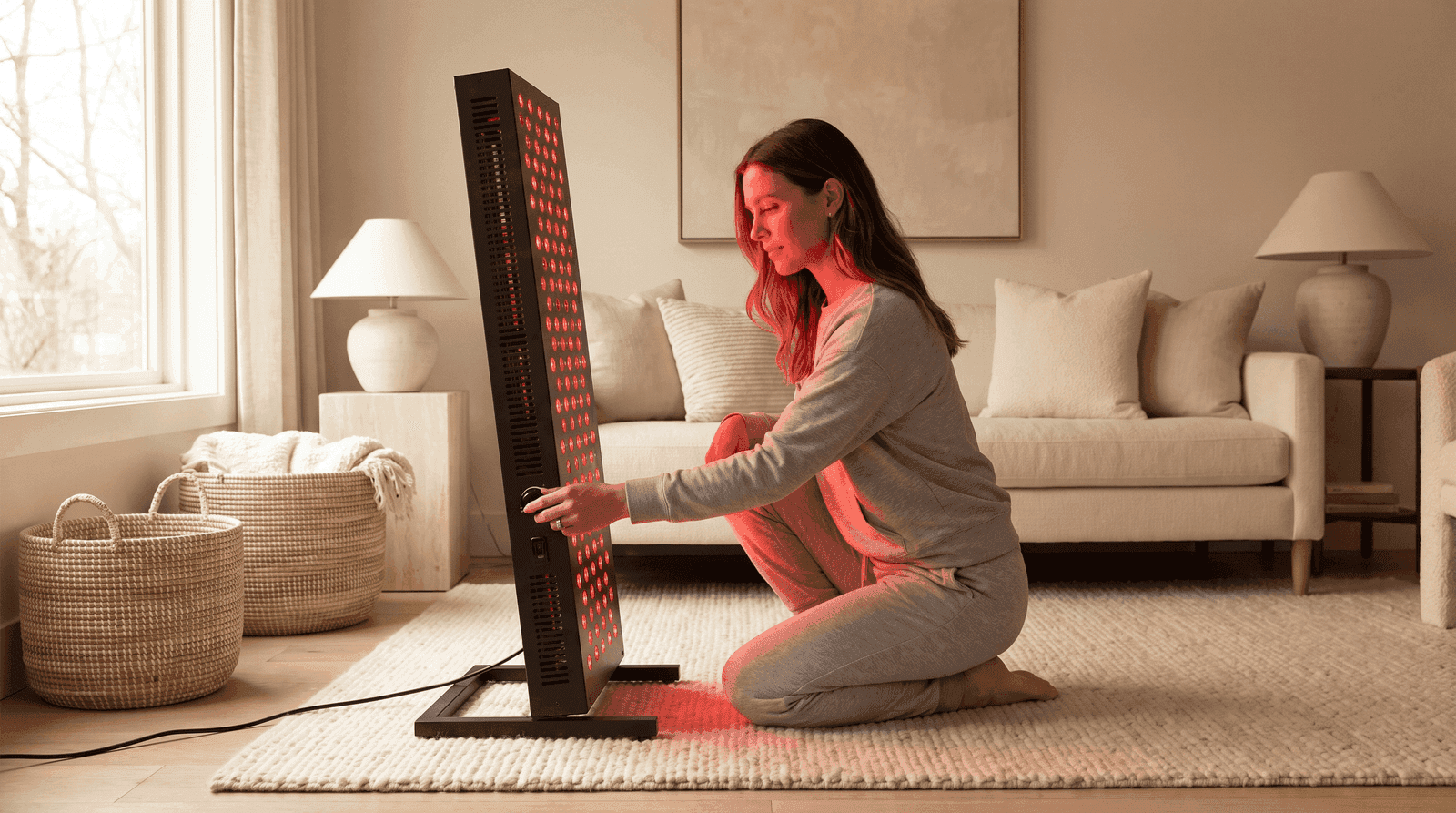
The Short Version
If you want a full-body panel, buy the Mito Red MitoPRO 1500X. It is not the brightest panel we researched, and we will not pretend it is. It is the only one whose maker publishes a real spectroradiometer figure (>73 mW/cm² at 6 in) alongside the inflated marketing number every other brand hides behind. Independent spectrometer testing put it at 68 mW/cm² average, and that honesty is worth more than a bigger number you cannot trust.
The gap between what these devices claim and what they measure runs through the whole category. Independent testers using calibrated spectrometers found that every full-body panel we examined measured 33% to 65% below its advertised irradiance. The worst offender in our dataset was a face mask claiming 70 mW/cm² that measured about 8. Manufacturers derive their headline numbers from solar power meters, which read roughly twice as high as spectrometers on this kind of light. So the spec sheet you are shopping from is, industry-wide, about double the truth.
We have not put these devices in a lab ourselves. What follows is research-based: we cross-referenced manufacturer specs against independent spectrometer measurements from testers who publish their methodology (primarily Light Therapy Insiders / Alex Fergus), verified every FDA clearance by K-number in the openFDA database, and read the underlying clinical trials rather than the marketing summaries of them. Our full methodology is here.
Here are the picks, then the reasoning.
| Feature | MitoPRO 1500X | Hooga PRO1500 (HGPRO1500) Full Body Red Light Therapy Panel | Bestqool Pro100 |
|---|---|---|---|
| Wavelengths | 590nm / 630nm / 660nm / 810nm / 830nm / 850nm | 660nm / 850nm | 630nm / 660nm / 850nm / 940nm |
| Claimed irradiance | >160 mW/cm2 at 6 in (solar-meter-style figure); Mito Red also publishes a spectroradiometer figure of >73 mW/cm2 at... | 189 mW/cm2 at 6 inches (hoogahealth.com spec) | 109 mW/cm² at 3 in (manufacturer spec, bestqool.com product page); Bestqool's own marketing elsewhere cites ~90 mW/... |
| Measured irradiance | 68 mW/cm2 average at 6 in (spectrometer, 9-point grid) per Light Therapy Insiders panel roundup ; prior-gen MitoPRO... | 96 mW/cm2 peak / 86 mW/cm2 average at 6 inches, ~150 W total light output — Light Therapy Insiders (Alex Fergus) sp... | Independent 9-point measurement by Light Therapy Insiders: peak 65 mW/cm², average 51.7 mW/cm² at 6 in — roughly 42... |
| Coverage | 10 in x 43 in panel (~40.9 in LED-to-LED height); half-to-full-body coverage for most users, though narrow (~10 in wide) | panel 36 x 8.6 in; max coverage 60 x 29 in at 18 in distance | 25.4 x 10.8 in effective coverage at 6 in (manufacturer spec); panel itself 19.72 x 8.35 x 2.56 in, 6.61 lbs |
| Price band | $1,200-1,300 | $1,100-1,200 | $250-350 |
| FDA status | FDA-registered (no clearance) | FDA-registered (no clearance) | FDA-registered (no clearance) |
| Price/cm2 | $0.43-$0.47/cm2 | $0.55-$0.60/cm2 | $0.14-$0.20/cm2 |
| Check Price | Check Price | Check Price |
How We Picked
Three filters, applied in order.
Measured output over claimed output. A device's marketing irradiance is close to useless because the whole industry inflates it the same way. Where an independent spectrometer measurement exists, that number decides the ranking. Where it does not (no third-party lab has tested any handheld or belt in this set), we say so and weight the pick toward format fit and FDA status instead.
Verified FDA status, stated precisely. We looked up every clearance claim in openFDA. The result splits cleanly by format. No body panel in this category holds a 510(k) clearance; the best a panel gets is a general-wellness or facility registration, which is not clearance and does not mean the FDA evaluated the device. LED face masks and laser hair caps are the opposite: most carry real 510(k) clearances with K-numbers you can check. We use "registered" for panels and "cleared" only where a K-number exists.
Clinical plausibility of the use case. A device can be well-built and honestly specced and still be sold for something the evidence does not support. We separate the applications with real trial support (skin, hair, musculoskeletal pain) from the ones brands imply but studies do not back at consumer-device specs.
We do not take manufacturer money for coverage, and no ranking here changes based on affiliate terms.
Best Overall Panel: Mito Red MitoPRO 1500X
MitoPRO 1500X
Mito Red Light / panel
$1,200-1,300
- Wavelengths
- 590nm / 630nm / 660nm / 810nm / 830nm / 850nm
- Measured
- 68 mW/cm2 average at 6 in (spectrometer, 9-point grid) per Light Therapy Insiders panel roundup ; prior-gen MitoPRO...
- Value
- $0.43-$0.47/cm2
The MitoPRO 1500X wins on candor. Mito Red is the one brand in this dataset that dual-publishes: it shows the >160 mW/cm² solar-meter marketing figure and, on the same product page, a >73 mW/cm² spectroradiometer number that reflects how the panel actually performs. Independent testing of the current unit measured 68 mW/cm² average at 6 inches across a 9-point grid, and the prior-generation 1500+ measured 76.5 mW/cm² average against a claimed 170. That is a real gap, but it is a disclosed one, and it is smaller than most competitors hide.
The hardware backs it up. Six wavelengths (590, 630, 660, 810, 830, 850nm) from dual-chip LEDs, a 445W draw, and a 10 x 43 inch body that covers half to most of an adult at once, though at about 10 inches wide it is a tall, narrow beam rather than a broad wall of light. Three-year warranty, touchscreen, app control. It sits in the $1,200-1,300 range.
The honest caveat: it is narrow. If you want to treat your back and both shoulders in one pass without repositioning, you will be moving around. For that use the wider Hooga is a better geometry.
Best Value Full-Body Panel: Hooga PRO1500
Hooga PRO1500 (HGPRO1500) Full Body Red Light Therapy Panel
Hooga / panel
$1,100-1,200
- Wavelengths
- 660nm / 850nm
- Measured
- 96 mW/cm2 peak / 86 mW/cm2 average at 6 inches, ~150 W total light output — Light Therapy Insiders (Alex Fergus) sp...
- Value
- $0.55-$0.60/cm2
The Hooga PRO1500 is the value play for whole-body coverage. Independent spectrometer testing measured 96 mW/cm² peak and 86 mW/cm² average at 6 inches, with roughly 150W of total light output. Its own spec sheet claims 189 mW/cm², so the claim-to-reality gap is about 2x, typical for the category, not exceptional. What earns the pick is cost per measured watt: the tester pegged it near $7.50 per watt of real output, among the best value in the roundup, and its 36 x 8.6 inch panel throws a wider field than the Mito.
It runs two wavelengths only (measured around 650-670nm red and 860nm NIR, both accurate), so you lose the amber and mid-NIR bands the Mito offers. For most people chasing skin plus recovery, 660/850 is the pair that matters and the extras are marginal. It carries a standard "not evaluated by the FDA" disclaimer: general-wellness product, no clearance, like every panel here. Priced in the $1,100-1,200 range with a 3-year warranty and a 60-day trial.
Best Budget Panel: Bestqool Pro100
Bestqool Pro100
Bestqool / panel
$250-350
- Wavelengths
- 630nm / 660nm / 850nm / 940nm
- Measured
- Independent 9-point measurement by Light Therapy Insiders: peak 65 mW/cm², average 51.7 mW/cm² at 6 in — roughly 42...
- Value
- $0.14-$0.20/cm2
If $1,000-plus is off the table, the Bestqool Pro100 is the tabletop to buy. Independent 9-point testing measured 65 mW/cm² peak and 51.7 mW/cm² average at 6 inches, roughly 42% below the brand's ~90 mW/cm² claim at that distance, which is squarely mid-pack for overclaiming, not a red flag. The tester rated it the best value tabletop panel in its class at around $5.90 per measured watt, verified the 660nm red as accurate, and clocked the NIR at 854nm against a claimed 850 (a rounding-level miss).
Understand what you are buying: a 25 x 11 inch coverage area at 6 inches. This treats a face, a shoulder, a knee, a patch of back, not your whole body at once. For targeted skin and small-joint use in the $250-350 range, nothing else here competes. One honesty note that applies to the whole brand: Bestqool uses "FDA Cleared," "FDA Class II," and "FDA Registered" interchangeably across its site without ever citing a K-number, and no Bestqool applicant appears in the FDA 510(k) database. Treat any clearance language from this brand as registration, not clearance.
Best LED Face Mask: CurrentBody Skin Series 2
CurrentBody Skin LED Light Therapy Mask: Series 2
CurrentBody / mask
$450-500
- Wavelengths
- 633nm / 830nm / 1072nm
- Measured
- 18.5 mW/cm² average, spectrometer-measured, 11.2 J/cm² fluence over a 10-minute session ()
- Value
- Coverage not comparable
Masks are where FDA clearance becomes real, and the CurrentBody Series 2 holds a verified 510(k): K250966, cleared June 2025 as an over-the-counter full-face wrinkle treatment (product code OHS, applicant Shenzhen Kaiyan). 510(k) cleared for wrinkle reduction It runs 633nm red, 830nm near-infrared, and 1072nm across 236 LEDs in a flexible silicone shell that actually contacts the skin, which matters for dose delivery.
The measurement reality check applies here too. Spectrometer testing found 18.5 mW/cm² average against a ~30 claim, delivering about 11.2 J/cm² over a 10-minute session. That is under the marketing figure but within the loosely cited 20-60 J/cm² cumulative range people target for skin, and the contact fit means less light is lost to distance than with a panel. It runs in the $450-500 range.
Two alternatives worth naming. The Omnilux Contour Face (~$350-400) measured close to its ~30 mW/cm² claim, one of the more honest masks, and traces to clearance K191629. If acne is your target rather than wrinkles, the Shark CryoGlow carries clearance K242796 covering mild-to-moderate inflammatory acne via a 415nm blue channel plus red and infrared, a broader indication than the wrinkle-only masks, in the $300-350 range. Note that Shark's own spec sheet lists the blue channel as "630nm," which is a copy error an independent LED-device designer corrected to 415nm.
Avoid the Qure Q-Rejuvalight Pro despite its genuine clearance (K230042). Spectrometer testing measured about 8 mW/cm² against a claimed 70, an 8-to-9x gap that is the worst overclaim in our entire dataset. At that output a 3-minute session delivers roughly 1.5 J/cm², below the effective dose range. A valid FDA clearance certifies safety and a marketing claim; it does not certify that the device hits its advertised power.
Best Targeted/Handheld: Hooga HG24
Hooga HG24 Handheld Red Light Therapy Device
Hooga / handheld
$0-50
- Wavelengths
- 660nm / 850nm
- Measured
- -
- Value
- Coverage not comparable
For spot treatment of a specific joint or muscle, a handheld beats a panel on convenience and beats a mask on penetration. The Hooga HG24 is a screw-in bulb-style unit running 660nm and 850nm, which gives you both the surface and deep-tissue bands in one head. Hooga claims 126 mW/cm² at 3 inches and 80 mW/cm² at 6 inches.
Here is the caveat we will not paper over: no independent spectrometer test exists for this SKU. The testing culture in this industry concentrates entirely on panels, so every handheld and belt in this category, including this one, is running on manufacturer numbers we cannot verify against a lab. Given the panel pattern, assume real output is meaningfully below the claim. What the HG24 has going for it is format (targeted, close-contact, cheap in the $0-50 range), the right wavelength pair, a 2-year warranty, and a 60-day trial.
If your target is skin rather than deep tissue and you want verified FDA status, the Solawave Radiant Renewal wand is a 510(k)-cleared handheld (K232863) at $150-200, but it is a multi-function beauty tool (630nm light plus galvanic current and warmth), not a serious near-infrared device, and Solawave's red-light advertising has drawn class-action inquiry attention. Buy it for its skincare purpose, not for pain.
Best for Hair Loss: iRestore Essential
iRestore Essential (ID-500)
iRestore (Freedom Laser Therapy, Inc.) / hair cap
$450-500
- Wavelengths
- 650nm
- Measured
- -
- Value
- Coverage not comparable
Pattern hair loss is one of the few consumer applications with real FDA clearances and supporting trials, so here the rules change: buy on the K-number and the evidence, not the wattage. 510(k) cleared, RCT-supported application
The iRestore Essential (ID-500) holds clearance K213094 (product code OAP) and packs 120 diodes (51 lasers plus 69 LEDs) at 650nm, in the $450-500 range with a 2-year warranty. It is the sensible entry point into cleared laser caps. iRestore cites a double-blind study reporting a 43.2% terminal hair count increase versus 5.7% for placebo over four months, though the same figure is reused across the product line, so read it as one underlying study rather than per-SKU data.
Two step-ups if budget allows. The iRestore Professional 282 (clearance K183417, 282 diodes, $850-900 range) roughly doubles the diode count. The Kiierr 272 Premier (clearance K181878, 272 lasers and no LEDs, $1,150-1,200 range) is the laser-purist option and is heavily marketed to women. All three are legitimately cleared. The honest framing: a hair-cap 510(k) under product code OAP establishes substantial equivalence to an already-cleared device, which is a safety-and-similarity bar, not proof this specific cap will regrow your hair. Consistency (sessions three times a week for months) matters more than which cleared cap you pick, and stopping treatment returns follicles toward baseline.
Claimed vs. Measured: The Number That Runs the Category
This is the table to internalize before you spend anything. Every figure below is an independent spectrometer measurement paired with the manufacturer's claim at a comparable distance. This isn't a few bad actors; it's how the whole category prices its spec sheets.
| Device | Format | Claimed | Independently measured | Gap | Source |
|---|---|---|---|---|---|
| Mito Red MitoPRO 1500X | Panel | >160 mW/cm² (solar) / >73 (spectro) | 68 mW/cm² avg @ 6 in | ~57% below solar claim | LTI |
| Hooga PRO1500 | Panel | 189 mW/cm² @ 6 in | 96 peak / 86 avg @ 6 in | ~49% below (avg) | LTI |
| PlatinumLED BIOMAX 900 | Panel | 135 mW/cm² @ 6 in | 90.3 avg / 113 peak @ 6 in | ~33% below (avg) | LTI |
| Bestqool Pro100 | Panel | ~90 mW/cm² @ 6 in | 65 peak / 51.7 avg @ 6 in | ~42% below (avg) | LTI |
| Joovv Solo 3.0 | Panel | >100 mW/cm² | 72.4 peak / 59.2 avg | ~41% below (avg) | LTI |
| CurrentBody Series 2 | Mask | ~30 mW/cm² | 18.5 avg | ~38% below | LTI |
| Qure Q-Rejuvalight Pro | Mask | 70 mW/cm² | ~8 avg | ~89% below | LTI |
The same solar-meter inflation described above drives every row: a claimed 189 becomes a measured 86, and a claimed 70 becomes a measured 8. Two consequences for you. First, never compare two devices on their spec sheets, since you are comparing two differently-inflated marketing numbers. Second, discount any unverified claim by roughly half as a working assumption, then check whether a spectrometer test exists before you believe better.
PlatinumLED is the cautionary tale on how far this goes. In May 2025, TINA.org investigated the brand for FDA logo misuse and false "FDA approved" claims; the company removed both after the inquiry. The BIOMAX 900 is a genuinely capable panel (its ~33% gap is the smallest here), but the brand's regulatory language was not trustworthy, which is exactly why we grade status by K-number instead of by what the box says.
What Actually Matters in a Spec Sheet
Wavelength, and only two bands. Red at 630-680nm works on skin: it reaches the dermis and stimulates the fibroblasts that make collagen. Near-infrared at 800-880nm penetrates deeper for muscle and joint targets. Everything else on a multi-wavelength box (590nm amber, 480nm blue, 1060nm) gets a few percent of the power budget and should not sway your decision. Accuracy matters more than count: independent testing has caught "850nm" devices peaking at 854nm and a mask whose blue channel was mislabeled by 200 nanometers. If a brand publishes a spectral analysis, that is a good sign.
Irradiance, halved. Power at the skin determines dose, so apply the solar-meter discount above before you trust any figure. Effective doses for most applications land between 10 and 60 J/cm², which is irradiance (mW/cm²) times exposure seconds divided by 1000. A panel honestly delivering 60-90 mW/cm² at 6 inches reaches those doses in 10-20 minutes. A mask at 18 mW/cm² needs a longer session or repeated ones to accumulate the same energy, which is fine as long as you are honest about it.
Coverage against price. This is where format discipline saves money. Full-body coverage with real measured output costs $1,100-1,300 and there is no shortcut. A tabletop panel treating a 25 x 11 inch area runs $250-350 and handles skin and single joints. A cleared face mask ($350-500) treats exactly one thing well. Buying a $500 mask expecting whole-body recovery, or a $40 bulb expecting panel-grade dose, is the most common way people waste money in this category.
The Evidence, With Real Trials Attached
Red light therapy has genuine clinical support for a defined set of uses. It also gets sold for a lot it cannot do. Here are four randomized controlled trials — verified by PMID — covering the applications where the evidence is strongest.
| Study | N | Protocol | Finding |
|---|---|---|---|
| Wunsch & Matuschka, 2014 (Photomed Laser Surg) | 136 | 611-650nm red / polychromatic, 2x weekly x 15 weeks | Significant improvement in skin roughness, wrinkle depth, and ultrasound-measured intradermal collagen density vs. control |
| Lanzafame et al., 2013 (Lasers Surg Med) — males | 44 | 655nm laser+LED helmet, every other day x 16 weeks | 35% increase in hair count vs. sham in men with androgenetic alopecia (P=0.003) |
| Lanzafame et al., 2014 (Lasers Surg Med) — females | 47 | 655nm laser+LED helmet, home use, 16 weeks | Significant hair-count increase vs. sham in women, comparable to the male result |
| PBM for knee osteoarthritis RCT, 2025 (Lasers Med Sci) | 65 | 790nm, 4 J/point over 9 knee sites, WALT dosing | Significant pain reduction (VAS) and improved WOMAC/KOOS function vs. sham and control |
Read the pattern. Skin collagen and Hair (androgenetic alopecia) have double-blind, sham-controlled trials with measurable effect sizes. Musculoskeletal pain is real but modest and often fades after the treatment period. What you will not find here are trials supporting the claims brands make about testosterone, thyroid function, fat loss, or brain benefits from standing in front of a panel. Systemic hormonal / metabolic effects Near-infrared at 850nm penetrates a few centimeters of soft tissue, not through the chest wall to an organ. We break down each application in what the benefits evidence actually says and cover the fundamentals in what red light therapy is.
Who Should Not Buy One
If your target is a systemic claim. Testosterone, thyroid, cortisol, fat loss, cognitive enhancement: the penetration physics do not support these at panel exposure, and the trials that show hormonal effects use direct-contact intrascrotal or intranasal devices, not ambient light. Buying a $1,300 panel for these outcomes is buying disappointment.
If you will not commit to weeks of consistency. Every positive trial above accumulates its effect over 15-16 weeks of regular sessions. Skin results show up at 8-12 weeks, hair at 16-26. Most people use a device for two or three weeks and quit before the biology could respond. If that is you, spend nothing. Our dosing guide and how-to guide exist because protocol, not gear, is where results are usually lost.
If you are pregnant, photosensitive, on photosensitizing medication, or have an active skin cancer or a thyroid condition affecting the treatment area. These warrant a doctor's sign-off first. Red light is low-risk, not no-risk; we cover the real contraindications and the occasional eye-strain and skin-irritation reports in red light therapy side effects.
If you expect the spec sheet to be true. By now the theme is clear. Go in assuming the advertised irradiance is roughly double reality, prefer devices with an independent measurement, verify any FDA clearance by K-number, and match the format to the job. Do that and this is a reasonable, evidence-backed purchase for skin, hair, and pain. Skip it and you are buying a light-up marketing claim.
Compare full specs, measured numbers, and verified clearances for every device we track in the device database.
LightTherapyIQ covers the clinical evidence on light therapy devices. No manufacturer pays for editorial coverage.
Frequently Asked Questions
What is the best red light therapy device overall?
For full-body use, the Mito Red MitoPRO 1500X is our top pick, not because it is the most powerful panel we looked at, but because it is the only brand that publishes an honest spectroradiometer figure (>73 mW/cm² at 6 in) next to its inflated marketing number. Independent testing measured it at 68 mW/cm² average, one of the smaller claim-to-reality gaps in the category. Best value full-body panel goes to the Hooga PRO1500 (roughly $7.50 per watt of measured output); best budget tabletop to the Bestqool Pro100 in the $250-350 range.
Are cheap red light therapy devices any good?
It depends on the format. A $250-350 tabletop panel like the Bestqool Pro100 measured 51.7 mW/cm² average on a spectrometer, which is enough therapeutic dose for targeted skin and small-area treatment. Sub-$50 screw-in bulbs are a different story: independent testing of budget bulbs (for example the Wolezek lamp) found intensity below advertised claims plus elevated EMF and flicker. Cheap face masks with FDA clearance can be legitimate because clearance requires a minimum safety and output bar. Cheap full-body coverage does not exist. Watch out for masks like the Qure, which measured about 8 mW/cm² against a claimed 70.
Are red light therapy devices FDA approved?
No consumer red light device is 'FDA approved' — that phrase applies to a stricter pathway most of these products never use. Body panels (Mito Red, Hooga, PlatinumLED, Joovv, Bestqool) are at most FDA-registered or listed, which is a facility or general-wellness registration, not a device clearance. Any panel brand claiming 'FDA cleared' or 'FDA approved' is overstating its status; PlatinumLED drew a TINA.org investigation in 2025 for exactly this. LED face masks and laser hair caps are different: many carry genuine 510(k) clearances (for example CurrentBody Series 2 under K250966, iRestore Essential under K213094), which you can verify by K-number in the FDA database.
What wavelength should I look for in a red light device?
Two bands have the strongest clinical support: red at 630-680nm (skin, collagen, surface inflammation) and near-infrared at 800-880nm (deeper tissue, muscle, joints). A device that covers both — most quality panels pair 660nm and 850nm — handles the widest range of uses. Wavelength accuracy matters more than the number of colors on the box: independent testing has caught devices labeled '850nm' peaking at 854nm and masks whose blue channel was mislabeled entirely. Extra wavelengths like 590nm amber or 1060nm get a tiny slice of the power budget and should not drive your decision.
How much should I spend on a red light therapy device?
Match the spend to the job. Targeted skin or spot treatment: a $150-200 FDA-cleared handheld or a $250-350 tabletop panel is plenty. Full-body coverage with real measured irradiance: expect the $1,100-1,300 range for a panel that actually delivers usable dose across a large area. LED face masks with 510(k) clearance run $350-500. FDA-cleared laser hair caps span $450-500 (entry) to $1,150-1,200 (highest diode count). Paying more does not guarantee more output — the Joovv Solo 3.0 sits in the $1,400-1,700 range and measured lower than panels costing less.
Do I need near-infrared, or is red light enough?
If your goal is skin — collagen, fine lines, acne inflammation, wound support — visible red at 630-660nm does the work and near-infrared adds little at the surface. If you want pain relief, muscle recovery, or joint support, near-infrared at 800-880nm penetrates deeper and is the band most pain trials used. Dual-wavelength panels (660nm + 850nm) cover both, which is why they dominate our panel picks. Skip devices that only offer one band if you want both use cases.