Omnilux Contour Face Review: The 510(k) Story and the Evidence (2026)
A research-based review of the Omnilux Contour Face LED mask. What FDA 510(k) clearance K191629 actually covers, the 633/830nm evidence, realistic timelines, and value vs. CurrentBody.
By LightTherapyIQ Editorial Team, Editorial
The short answer
We may earn a commission when you buy through links on this page. It does not change the order of our picks. How we evaluate devices
Omnilux Contour Face
The mask we reviewed$350-400FDA-cleared (K191629)
Jump to the details: Omnilux Contour FaceCheck priceCurrentBody Series 2
The main rival$450-500FDA-cleared (K250966)
Jump to the details: CurrentBody Series 2Check price
When to pick differently. The CurrentBody Series 2 has more LEDs and an extra near-infrared band, at a higher price. Choose it if you want more hardware.
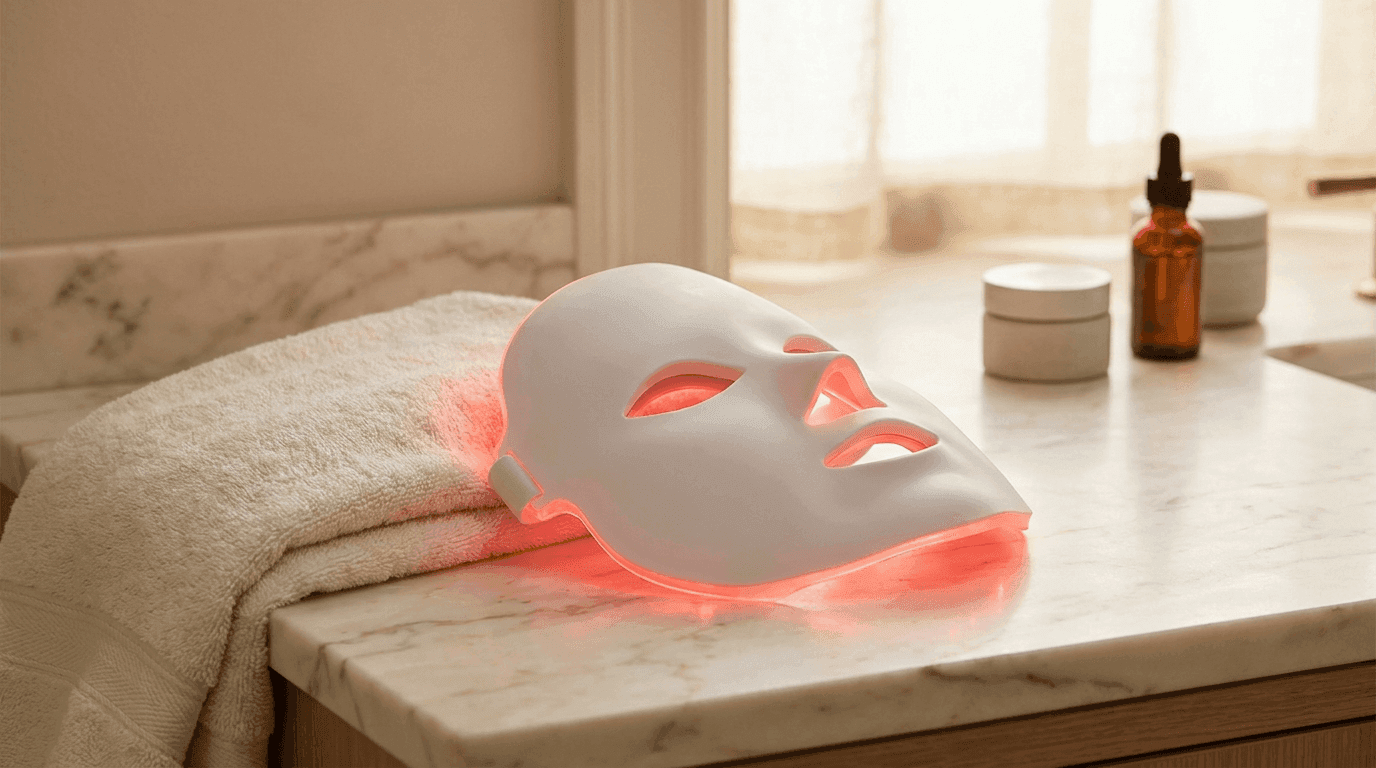
The Verdict, First
Buy the Omnilux Contour Face if you want an LED mask that carries a verified FDA 510(k) clearance, delivers close to its advertised power (a rarity in this category), and you will commit to months of consistent use for subtle wrinkle and texture improvement. Skip it if your target is active acne rather than fine lines (a blue-light mask suits that job), if you expect visible change in a few weeks, or if you want the highest LED count and an extra near-infrared band, where the CurrentBody Series 2 offers more hardware for a higher price.
We have not tested this mask on skin ourselves. This is research-based: we analyzed Omnilux's published specifications against independent measurements, verified the FDA clearance by K-number in the openFDA database, and read the underlying clinical trials rather than the marketing summaries of them. Our full methodology is here.
The Omnilux Contour Face is one of the more honest masks in a category built on inflated power claims, backed by a real clearance and by wavelengths with genuine trial support. Results are modest and slow, and that is the truth about LED masks generally, not a knock on this one.
The 510(k) Story: What "Cleared" Actually Means
This is the part most reviews get wrong, so start here. The Omnilux Contour Face traces to FDA 510(k) clearance K191629, product code OHS, an over-the-counter clearance for wrinkle reduction. 510(k) cleared for wrinkle reduction
A 510(k) clearance is not the same as FDA approval, and the difference matters:
- Cleared (510(k)) means the manufacturer showed the FDA that the device is substantially equivalent to a legally marketed one, on safety and intended use. The FDA reviewed it. This produces a K-number you can look up. The Omnilux has one.
- Approved (PMA) is a stricter, evidence-heavy pathway for higher-risk devices. Consumer LED masks do not use it. Any mask advertised as "FDA approved" is misstating its status.
One transparency caveat we hold ourselves to: the FDA record for K191629 lists the device as "faceLITE" from I-Smart Developments, and GUDID and MAUDE records tie the same manufacturer and the same product code (OHS) to the Omnilux Contour Face home device. Same manufacturer, same product code, but the FDA record itself does not print the "Omnilux" brand name. We treat the K-number as high-confidence, not manufacturer-confirmed, and we would rather tell you that than pretend the paper trail is cleaner than it is.
What the clearance covers is narrow and worth stating: it certifies that the device is safe and substantially equivalent for over-the-counter wrinkle reduction. It does not certify that the mask hits its advertised power, and it does not certify a specific result on your face. A valid clearance and an honest power number are two different things, and this mask happens to have both, which is not something every cleared mask can say.
Specs at a Glance
Contour Face
Omnilux / mask
$350-400
- Wavelengths
- 633nm / 830nm
- Measured
- ~28 mW/cm² independently measured (Alex Fergus / lighttherapyinsiders-linked comparison content referenced via redl...
- Value
- Coverage not comparable
| Spec | Omnilux Contour Face |
|---|---|
| Format | Flexible full-face LED mask |
| Wavelengths | 633nm red, 830nm near-infrared |
| LED count | 132 |
| Coverage | Full face |
| Claimed irradiance | ~30 mW/cm² (manufacturer-stated) |
| Measured irradiance | ~28 mW/cm² (independent, moderate confidence) |
| Warranty | 2 years |
| FDA status | Class II cleared, K191629 (OHS) |
| Price band | $350-400 range |
Two wavelengths, both chosen well. 633nm sits in the red band that acts on surface skin and collagen; 830nm sits in the near-infrared band that reaches deeper. There is no filler wavelength here padding the marketing, which is a point in its favor.
Claimed vs. Measured: A Rare Honest Number
This is where the mask stands out. Across the LED category, manufacturers read irradiance with solar power meters that register roughly twice as high as calibrated spectrometers, so advertised power runs about double reality. A mask claiming 70 mW/cm² measured about 8. A CurrentBody mask claiming ~30 measured 18.5.
The Omnilux Contour Face claims ~30 mW/cm² and measured about 28 in independent comparison content, one of the smallest claim-to-reality gaps among masks we examined. We hold this at moderate confidence: the primary spectrometer review URL for this exact SKU was not directly located, and the figure comes from comparison resources rather than a single named lab writeup. But even discounted, the pattern is consistent across sources: the Omnilux is among the more honest masks on power, not among the inflated ones.
Measured close to claimed outputThat honesty translates into dose. Dose is irradiance times time:
J/cm² = mW/cm² × seconds ÷ 1000
At a measured 28 mW/cm², a standard 10-minute Omnilux session delivers about 16.8 J/cm² (28 × 600 ÷ 1000). That sits inside the loosely cited 20-60 J/cm² cumulative range people target for skin when sessions accumulate across a week. To reach a single-session 10 J/cm² takes about 6 minutes. Because the mask contacts the face, less light is lost to distance than with a panel held inches away, so more of that measured output reaches the skin.
Build, Fit, and Daily Use
The hardware is a flexible mask rather than a rigid shell, which matters more than it sounds. Contact fit determines how much of the measured output reaches skin: a rigid mask that stands off the face at the cheeks and brow loses light to the air gap, while a mask that conforms delivers its dose where it is aimed. The Omnilux uses a flexible form with 132 LEDs across the face, and the 2-year warranty is standard for the category and matches or beats several rivals.
Daily use is straightforward. Sessions run about 10 minutes, cordless enough to wear while doing something else, and the protocol asks for three to five sessions a week. The mask covers the full face in one placement, so unlike a panel there is no repositioning and no dose math to track per region: one session is one dose to the whole treatment area. The eye cutouts and the closed-eye recommendation are worth respecting, since bright LEDs at close range are a common source of the eye-strain reports we cover in the side effects guide.
What the mask does not do is treat anything below the face. It is a facial-skin device. For neck, chest, hands, or body skin you would need a separate device, and for deep-tissue or muscle targets a mask is the wrong tool entirely; that is panel or handheld territory, covered in our best panels roundup.
The Clinical Evidence for 633/830nm
The wavelengths this mask uses have real trial support for skin. Here are the studies, verified by PMID.
| Study | N | Protocol | Finding |
|---|---|---|---|
| Lee et al., 2007 (J Photochem Photobiol B) | 76 | 830nm, 633nm, or combined LED; twice weekly x 4 weeks; split-face, double-blind, placebo-controlled | Wrinkle reduction up to 36% and skin elasticity increase up to 19%, with histology showing increased collagen and elastic fibers |
| Wunsch & Matuschka, 2014 (Photomed Laser Surg) | 136 | 611-650nm red (~9 J/cm²), 2x weekly x 30 sessions; randomized, controlled | Significant improvement in wrinkle depth, skin roughness, and ultrasound-measured intradermal collagen density vs. control |
| Barolet et al., 2009 (J Invest Dermatol) | in vitro + split-face clinical | 660nm pulsed LED; 12 treatments; single-blinded (adjacent red wavelength, not 633nm) | Reversed collagen downregulation and MMP-1 upregulation; ~31% rise in type-1 procollagen; visible wrinkle improvement in 87% of clinical subjects |
Read the studies honestly. The Lee 2007 trial is the most directly relevant: it used the exact 633nm and 830nm wavelengths this mask runs, in a double-blind, placebo-controlled, split-face design, and found measurable wrinkle and elasticity gains over four weeks. Wunsch 2014 used red light in an adjacent band and confirmed collagen density increases over 30 sessions. The Barolet 2009 study is mechanistic and clinical but used 660nm pulsed light, not 633nm, so we cite it as adjacent-wavelength support for the collagen mechanism rather than as a test of this device. We flag that difference rather than blur it.
Skin collagen / wrinkles (633-660nm) The band has genuine, repeated support. What it does not support is dramatic or fast change. Effect sizes are modest, cumulative, and measured over weeks to months.
A note on what the evidence does not reach. The trials above measured wrinkle depth, roughness, elasticity, and collagen density under controlled protocols. They did not test the mask's marketing-adjacent implications: no controlled data supports a mask "detoxifying" skin, resolving pigmentation on its own, or replacing a retinoid or sunscreen. Pigmentation / broad skin claims The measured, repeatable effect is collagen-mediated improvement in fine lines and texture. That is a real benefit and a narrow one. Read it as one input to a skincare routine, not a standalone fix, and pair it with the basics (sun protection, a proven active) that carry stronger evidence for aging skin. We separate the supported applications from the overreach in what the benefits evidence actually says.
A Realistic Timeline
Set expectations against the trials, not the before-and-after marketing. The Lee study ran 4 weeks; Wunsch ran 30 sessions across roughly 15 weeks. Real-world skin change from an at-home mask follows the same slow curve.
- Weeks 1-4: little visible change. Skin may feel smoother; measurable wrinkle change is unlikely yet.
- Weeks 8-12: the window where the trials began showing measurable improvement in wrinkle depth and texture. Subtle, not transformative.
- Beyond 12 weeks: continued consistent use maintains and slowly builds the effect. Stopping returns skin toward baseline over time, because the collagen stimulus is ongoing, not permanent.
The protocol that produces this is roughly 10-minute sessions, three to five times a week. The single biggest reason people see nothing is quitting inside the first month. Our dosing guide covers the protocol logic in depth.
The Main Rival: CurrentBody Series 2
The mask most cross-shopped with the Omnilux is the CurrentBody Series 2. Compare them on what they deliver.
| Feature | Contour Face | CurrentBody Skin LED Light Therapy Mask: Series 2 |
|---|---|---|
| Wavelengths | 633nm / 830nm | 633nm / 830nm / 1072nm |
| Claimed irradiance | ~30 mW/cm² (manufacturer-stated energy output; distance/measurement conditions not specified) | ~30 mW/cm² (manufacturer/brand-cited figure; distance/conditions not specified on product page) |
| Measured irradiance | ~28 mW/cm² independently measured (Alex Fergus / lighttherapyinsiders-linked comparison content referenced via redl... | 18.5 mW/cm² average, spectrometer-measured, 11.2 J/cm² fluence over a 10-minute session () |
| Coverage | full face | full face ("Best-Fit" flexible liquid silicone) |
| Price band | $350-400 | $450-500 |
| FDA status | FDA-cleared (K191629) | FDA-cleared (K250966) |
| Price/cm2 | - | - |
| Check Price | Check Price |
The tradeoff is clear once you read past the LED count. The CurrentBody Series 2 brings more hardware: 236 LEDs to the Omnilux's 132, a third wavelength at 1072nm, and a flexible liquid-silicone shell for close contact. It holds its own verified clearance, K250966, cleared June 2025.
But on the number that drives dose, the Omnilux measured higher relative to claim. The CurrentBody measured 18.5 mW/cm² against a ~30 claim (delivering about 11.2 J/cm² over a 10-minute session), while the Omnilux measured about 28 against the same ~30 claim (about 16.8 J/cm² over 10 minutes). The Omnilux also sits a price band lower, in the $350-400 range against the CurrentBody's $450-500 range. For output-per-dollar the Omnilux wins; for the extra NIR band and the highest LED count, the CurrentBody does. Both are honest, cleared, defensible buys, which is more than most of this category can claim.
Price-Band Value Over Two Years
LED masks look expensive as a one-time purchase and cheap as a habit. In the $350-400 range, used three to five times a week over two years, a session count of roughly 300-500 puts the cost around $0.35-0.50 per session. A single professional in-office LED facial runs well above that, so the mask pays for itself inside a few months of the routine it replaces, provided you keep the routine.
The value math only works if you use it. A mask in this price band used twice and abandoned costs roughly $175 per session and delivers nothing, which is the most common way people waste money on this device. The break-even against professional LED facials arrives fast on paper and never in practice for anyone who treats the mask as a novelty. Buy it as a standing habit or do not buy it, because the per-session economics that make it a good deal depend entirely on the routine you keep after the first month.
Alternatives Worth Naming
If you want more hardware and price is not the limit: the CurrentBody Series 2, covered above, adds a 1072nm band, 236 LEDs, and a silicone contact fit in the $450-500 range. It measured lower on output-per-claim but brings the most LEDs in the class.
If your target is acne, not wrinkles: a mask with a 415nm blue channel fits the job the Omnilux does not. The Shark CryoGlow carries an acne clearance (K242796) covering mild-to-moderate inflammatory acne alongside red and infrared, in the $300-350 range. Read blue light therapy for acne before choosing, because the mechanism is different from wrinkle treatment.
If you want to spend less on facial skin: a 510(k)-cleared handheld wand treats smaller areas for the $150-200 range. It trades whole-face coverage per session for a lower price and more time per treatment. See the handheld picks in our device database.
If you want whole-body coverage, not just the face: a mask is the wrong format. A panel treats large areas and both the red and near-infrared bands; the best panels roundup covers the measured field.
Who Should Buy It, and Who Should See a Dermatologist First
Buy the Omnilux Contour Face if:
- You want a cleared mask that delivers close to its stated power, for fine lines and skin texture.
- You will use it three to five times a week for months, not weeks.
- You want the honesty-and-value pick and do not need the CurrentBody's extra LEDs and NIR band.
See a dermatologist before buying, or instead of buying, if:
- Your primary concern is active acne, not wrinkles. Red light helps inflammation modestly, but blue light at 415nm targets acne bacteria directly; read blue light therapy for acne before you spend on a red mask for this.
- You are pregnant, photosensitive, on photosensitizing medication, or have a skin condition or lesion in the treatment area. LED light is low-risk, not no-risk, and these warrant a doctor's sign-off. We cover the real contraindications and the occasional eye-strain and irritation reports in red light therapy side effects.
- You want a clinical-grade result on deep wrinkles or significant photoaging. An at-home mask produces subtle change; a dermatologist can tell you whether a procedure fits your goals better.
Compare full specs, measured numbers, and verified clearances for every device we track in the device database, and see our best LED face masks roundup for the full field.
LightTherapyIQ covers the clinical evidence on light therapy devices. No manufacturer pays for editorial coverage.
Frequently Asked Questions
Is the Omnilux Contour Face FDA cleared or FDA approved?
Cleared, not approved. The Omnilux Contour Face traces to FDA 510(k) clearance K191629 (product code OHS), an over-the-counter clearance for wrinkle reduction. 'Cleared' means the FDA reviewed it and found it substantially equivalent to a legally marketed device. 'Approved' is a stricter pathway (PMA) that consumer LED masks do not use, so any product calling itself 'FDA approved' is overstating its status. No LED mask is FDA approved.
How long does the Omnilux Contour Face take to work?
Plan on 12 or more weeks of consistent use for subtle, measurable change, not a transformation. Omnilux's protocol is roughly 10-minute sessions three to five times a week. The clinical trials behind 633/830nm light show improvements in wrinkle depth and collagen density over 4 to 15 weeks of repeated sessions, and the effect is real but modest. Anyone stopping at two or three weeks quits before the biology can respond.
Omnilux Contour Face vs CurrentBody Series 2 — which is better?
They are close. The Omnilux measured near its ~30 mW/cm² claim (about 28 measured, one of the more honest masks), while the CurrentBody Series 2 measured 18.5 mW/cm² against a similar ~30 claim. Both carry verified 510(k) clearances (Omnilux K191629, CurrentBody K250966) and both use 633/830nm. Omnilux is the honesty pick and sits a price band lower; CurrentBody adds a 1072nm band, 236 LEDs, and a flexible silicone contact fit. For output-per-dollar, the Omnilux.
Does the Omnilux Contour Face actually work for wrinkles?
For fine lines and skin texture, the wavelengths have genuine support: randomized and controlled trials on 633nm and 830nm light show measurable reductions in wrinkle depth and increases in intradermal collagen. The Omnilux delivers close to its claimed dose, which many masks do not. Expectations should stay realistic: the effect is subtle, cumulative over months, and returns toward baseline if you stop. It is skincare-grade improvement, not a substitute for a dermatologist's procedures.
Is the Omnilux Contour Face worth it?
If you will use it consistently for months, the value math is reasonable. In the $350-400 range, spread over two years of three-to-five sessions a week, the cost lands around $0.35-0.50 per session, cheaper than a single professional LED facial. It is worth it as a long-term skincare habit for wrinkles and texture. It is not worth it for anyone expecting fast results, treating active acne (a blue-light mask fits that better), or unwilling to use it several times a week.