Best Red Light Therapy Panels (2026): What the Spectrometers Actually Measured
We ran the five most-marketed red light therapy panels against independent spectrometer data. Every one measured 33-57% below its claimed irradiance, and that changes your session times.
By LightTherapyIQ Editorial Team, Editorial
Our picks
We may earn a commission when you buy through links on this page. It does not change the order of our picks. How we evaluate devices
PlatinumLED BIOMAX 900
Best measured output$1,200-1,300FDA-registered (no clearance)
Jump to the details: PlatinumLED BIOMAX 900Check priceHooga PRO1500
Best value full panel$1,100-1,200FDA-registered (no clearance)
Jump to the details: Hooga PRO1500Check priceBestqool Pro100
Best budget or first panel$250-350FDA-registered (no clearance)
Jump to the details: Bestqool Pro100Check price
When to pick differently. For a first panel, start with the Bestqool Pro100. PlatinumLED removed false "FDA approved" claims from its marketing after a 2025 TINA.org inquiry.
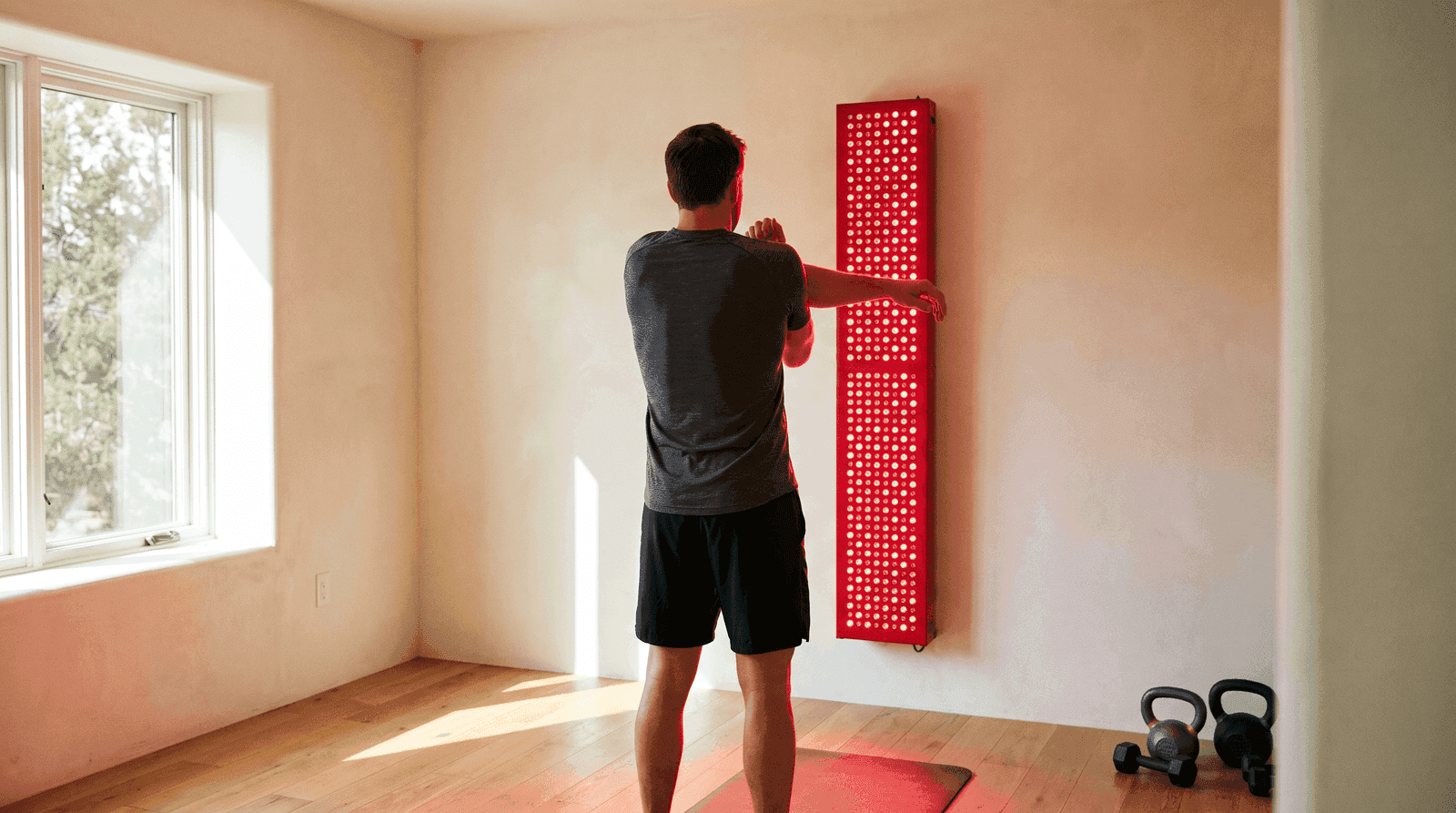
Red light therapy panels are sold on one number: irradiance, the power density reaching your skin, quoted in milliwatts per square centimeter. That number decides how long a session has to run to deliver a useful dose. It is also the number the industry inflates most.
We pulled the marketed irradiance for the five most-visible home panels and set each one against independent spectrometer measurements. Every panel measured below its claim. The gaps run from 33% to 57%. This guide starts there, because the gap is the difference between a 3-minute session and an 8-minute one.
The verdict, up front
Buy on measured output and coverage, not on the wattage printed on the box.
- Best measured output: PlatinumLED BIOMAX 900. 90.3 mW/cm² average measured at 6 inches, the smallest overclaim gap here (33%), seven wavelengths. Priced in the $1,200-1,300 band.
- Best value full panel: Hooga PRO1500. 86 mW/cm² average measured, around 150W total light output, in the $1,100-1,200 band. Two wavelengths only.
- Best budget / first panel: Bestqool Pro100. Tabletop size, $250-350 band, 51.7 mW/cm² average measured. Covers a torso-sized zone, not a full body.
- Best half-to-full-body coverage: Mito Red MitoPRO 1500X. A 10-by-43-inch panel, six wavelengths, and the only brand in this set that publishes its own spectroradiometer figure alongside the marketing number.
BIOMAX 900
PlatinumLED Therapy Lights / panel
$1,200-1,300
- Wavelengths
- 480nm / 630nm / 660nm / 810nm / 830nm / 850nm / 1060nm
- Measured
- 90.3 mW/cm2 average / 113 mW/cm2 peak at 6 inches, ~186 W total therapeutic output — Alex Fergus spectrometer test,
- Value
- $0.43-$0.47/cm2
Hooga PRO1500 (HGPRO1500) Full Body Red Light Therapy Panel
Hooga / panel
$1,100-1,200
- Wavelengths
- 660nm / 850nm
- Measured
- 96 mW/cm2 peak / 86 mW/cm2 average at 6 inches, ~150 W total light output — Light Therapy Insiders (Alex Fergus) sp...
- Value
- $0.55-$0.60/cm2
Bestqool Pro100
Bestqool / panel
$250-350
- Wavelengths
- 630nm / 660nm / 850nm / 940nm
- Measured
- Independent 9-point measurement by Light Therapy Insiders: peak 65 mW/cm², average 51.7 mW/cm² at 6 in — roughly 42...
- Value
- $0.14-$0.20/cm2
MitoPRO 1500X
Mito Red Light / panel
$1,200-1,300
- Wavelengths
- 590nm / 630nm / 660nm / 810nm / 830nm / 850nm
- Measured
- 68 mW/cm2 average at 6 in (spectrometer, 9-point grid) per Light Therapy Insiders panel roundup ; prior-gen MitoPRO...
- Value
- $0.43-$0.47/cm2
The Joovv Solo 3.0 is the reference premium panel and the one we do not recommend on value grounds. It measured 59.2 mW/cm² average, the lowest of the large panels here, at the highest price. More on that below.
How we picked
Panel selection follows the money: these are the five panels that dominate search and affiliate placement for "red light therapy panel." We then ignored the manufacturer spec sheets for the ranking and used independent measurement instead.
The measurement source for every panel here is spectrometer testing published by Light Therapy Insiders, whose reviewer runs a calibrated spectrometer across a nine-point grid on the panel face at a fixed 6-inch distance. A spectrometer reads only the light in the therapeutic band. A solar power meter, which is what most manufacturers use for their spec sheets, responds to a wider slice of the spectrum and reads roughly twice as high. That single instrument difference explains most of the claimed-versus-measured gap.
Where a brand publishes its own spectroradiometer number (only Mito Red does), we note it. Our full ranking method is on the methodology page. We rank on measured irradiance at 6 inches, measured total optical output, coverage area, wavelength count, warranty, and price band. We do not rank on wattage draw, which measures what the panel pulls from the wall, not what reaches your body.
Claimed vs measured irradiance
This is the table no manufacturer publishes and no other roundup runs across the category. Claimed figures are the marketing irradiance at 6 inches. Measured figures are the spectrometer average at 6 inches. Delta is the shortfall.
| Panel | Claimed (6 in) | Measured avg (6 in) | Delta | Source |
|---|---|---|---|---|
| Mito MitoPRO 1500X | ~160 mW/cm² | 68 mW/cm² | −57% | LTI panel roundup |
| Hooga PRO1500 | 189 mW/cm² | 86 mW/cm² | −54% | LTI review |
| Bestqool Pro100 | ~90 mW/cm² | 51.7 mW/cm² | −43% | LTI review |
| Joovv Solo 3.0 | >100 mW/cm² | 59.2 mW/cm² | −41% | LTI review |
| PlatinumLED BIOMAX 900 | 135 mW/cm² | 90.3 mW/cm² | −33% | LTI review |
Two things stand out. The panel with the highest marketing number (Hooga, 189 mW/cm²) is not the panel with the highest measured output (PlatinumLED, 90.3 mW/cm²). And the brand with the largest headline gap (Mito, −57%) is also the only one publishing an honest secondary figure: Mito Red lists a spectroradiometer reading above 73 mW/cm² on the same product page as the >160 marketing number, and the independent measurement of 68 mW/cm² sits close to that honest figure. The overclaim is in the marketing line, not the lab data the brand also shows you.
What the gap does to your dose
Dose is what produces a biological effect, not session length. The formula from our dosing guide is:
Dose (J/cm²) = Irradiance (mW/cm²) × Time (seconds) ÷ 1000
Rearranged for the number you want, the session time to hit a target dose:
Time (seconds) = Target dose × 1000 ÷ Irradiance
Work a real example on the MitoPRO 1500X. A common muscle-recovery target is 30 J/cm² at the skin.
- At the marketed 160 mW/cm²: 30,000 ÷ 160 = 188 seconds, about 3.1 minutes.
- At the measured 68 mW/cm²: 30,000 ÷ 68 = 441 seconds, about 7.4 minutes.
The measured session is 2.4 times longer than the marketing number implies. Someone who reads "160 mW/cm²," runs a 3-minute session, and expects a recovery dose is delivering closer to 12 J/cm². That undershoots the 20-60 J/cm² range the muscle-recovery literature used.
The gap compounds with distance. Irradiance falls with the inverse square of distance, so a user who sits 12 inches back instead of 6 loses roughly three-quarters of even the measured number. Marketing overclaim plus casual distance is how a panel rated for "therapeutic" doses delivers a fraction of one. Sit at the measured distance and lengthen the session.
The picks in detail
Best measured output: PlatinumLED BIOMAX 900
The BIOMAX 900 measured 90.3 mW/cm² average and 113 mW/cm² peak at 6 inches, around 186W of total therapeutic output, the strongest of the five. Its 33% overclaim gap is the smallest here, which means its spec sheet is the least misleading. Seven wavelengths span 480nm to 1060nm, though the 1060nm and 480nm channels take only about 4% and 2% of the power budget respectively, so treat them as extras rather than reasons to buy.
The honest cons are real. PlatinumLED drew a TINA.org investigation in May 2025 that found FDA logo misuse and false "FDA approved" claims on its marketing; the company removed the logo and the claim after the inquiry. The 60-day trial carries a 20% restocking fee on non-defective returns. And the panel sits in the $1,200-1,300 band, so it is not a first-panel budget buy. The FDA-logo history is a marketing-integrity flag, not a device-safety one, but it belongs on the record.
Best value full panel: Hooga PRO1500
Hooga measured 86 mW/cm² average (96 peak) with roughly 150W of light output, which works out near $7.33-8.00 per watt in its $1,100-1,200 band. That is the strongest measured-output-per-dollar of the full-size panels. Wavelengths measured accurate at roughly 660nm red and 860nm NIR, flicker was clean, and measured EMF at 6 inches was 0.16 µT, well inside safe range despite the marketing "0.0 µT" claim.
The cons: only two wavelengths, and the marketing number (189 mW/cm²) is about double the measured output, the largest ratio in the set even though the absolute measured figure is good. Buy it for output per dollar, not because the box number is honest.
Best budget / first panel: Bestqool Pro100
At the $250-350 band the Pro100 is the value entry point, rated near $6 per watt by Light Therapy Insiders and holding a 4.7-star average across several hundred Amazon ratings. It measured 51.7 mW/cm² average (65 peak) at 6 inches.
Two honest limits. First, coverage: the panel face is about 20 by 8 inches, so it treats a torso-sized zone and cannot do a full body in one session. Second, the FDA language: Bestqool's own materials use "FDA Cleared," "FDA Class II," and "FDA Registered Establishment" interchangeably without citing a 510(k) number, and no Bestqool applicant record appears in the FDA 510(k) database. Read those claims as establishment registration, not product clearance. At 51.7 mW/cm² a 30 J/cm² muscle dose needs about 9.7 minutes per zone, so budget the time.
Best half-to-full-body coverage: Mito Red MitoPRO 1500X
The MitoPRO 1500X is a 10-by-43-inch tower that covers half to full body for most users standing at 6 inches, with six wavelengths (590, 630, 660, 810, 830, 850nm) and a 3-year warranty. It measured 68 mW/cm² average at 6 inches. It is the only brand here that dual-publishes: the >160 mW/cm² marketing number sits next to the brand's own spectroradiometer figure above 73 mW/cm², and Mito posts third-party lab tests. That transparency is why it takes the coverage pick despite the −57% headline gap.
The cons: the panel is narrow (about 10 inches wide), so "full body" means front-then-back repositioning for anything wider than your torso, and it sits in the $1,200-1,300 band. If you want width as well as height, plan on a second panel.
MitoPRO 1500X
Mito Red Light / panel
$1,200-1,300
- Wavelengths
- 590nm / 630nm / 660nm / 810nm / 830nm / 850nm
- Measured
- 68 mW/cm2 average at 6 in (spectrometer, 9-point grid) per Light Therapy Insiders panel roundup ; prior-gen MitoPRO...
- Value
- $0.43-$0.47/cm2
The premium panel we skip on value: Joovv Solo 3.0
The Joovv Solo 3.0 has the best build, app control, a pulsed Recovery+ mode, and a modular ecosystem. It also measured 59.2 mW/cm² average (72.4 peak) and about 85W total output, the lowest of the large panels, at a $1,400-1,700 price band. That is roughly $16-20 per watt of measured output, against about $6.50-7 for the BIOMAX 900. Independent testing also flagged elevated electric fields from the ungrounded plug (around 23 V/m at 6 inches). Buy it if you specifically want the ecosystem and app; do not buy it expecting more photons than a panel costing a third less.
Price per coverage: the number nobody publishes
Roundups compare price to wattage draw, which is close to meaningless. Two more honest ratios: price per square centimeter of panel face, and price per watt of measured optical output. Panel-face area is computed from published dimensions; it sets an upper bound on the area you can treat at once. Measured output is the spectrometer total where the tester published one.
| Panel | Panel face | Price band | Price / cm² of panel | Price / watt (measured) |
|---|---|---|---|---|
| Bestqool Pro100 | ~20 × 8 in (1,062 cm²) | $250-350 | ~$0.24-0.33 | ~$6 (LTI) |
| PlatinumLED BIOMAX 900 | ~36 × 12 in (2,787 cm²) | $1,200-1,300 | ~$0.43-0.47 | ~$6.45-6.99 |
| Mito MitoPRO 1500X | ~10 × 43 in (2,774 cm²) | $1,200-1,300 | ~$0.43-0.47 | not published |
| Hooga PRO1500 | ~36 × 8.6 in (1,997 cm²) | $1,100-1,200 | ~$0.55-0.60 | ~$7.33-8.00 |
| Joovv Solo 3.0 | ~36 × 8.75 in (2,032 cm²) | $1,400-1,700 | ~$0.69-0.84 | ~$16.47-20.00 |
Read the two columns together. Bestqool is cheapest per square centimeter but delivers the least measured irradiance and the smallest area, so it wins on entry price, not on delivered dose. PlatinumLED and Mito buy the most panel per dollar among the towers. Joovv is the most expensive on both metrics. The caveat: panel-face area is a ceiling, not a promise. Irradiance still governs whether the light hitting that area reaches a therapeutic dose, so use these ratios to compare value, then confirm the measured irradiance covers your target dose.
| Feature | BIOMAX 900 | Hooga PRO1500 (HGPRO1500) Full Body Red Light Therapy Panel | MitoPRO 1500X | Bestqool Pro100 | Joovv Solo 3.0 |
|---|---|---|---|---|---|
| Wavelengths | 480nm / 630nm / 660nm / 810nm / 830nm / 850nm / 1060nm | 660nm / 850nm | 590nm / 630nm / 660nm / 810nm / 830nm / 850nm | 630nm / 660nm / 850nm / 940nm | 660nm / 850nm |
| Claimed irradiance | 135 mW/cm2 at 6 inches (manufacturer, platinumtherapylights.com) | 189 mW/cm2 at 6 inches (hoogahealth.com spec) | >160 mW/cm2 at 6 in (solar-meter-style figure); Mito Red also publishes a spectroradiometer figure of >73 mW/cm2 at... | 109 mW/cm² at 3 in (manufacturer spec, bestqool.com product page); Bestqool's own marketing elsewhere cites ~90 mW/... | >100 mW/cm2 optical irradiance (Joovv spec; measurement distance not stated on current product page — historically... |
| Measured irradiance | 90.3 mW/cm2 average / 113 mW/cm2 peak at 6 inches, ~186 W total therapeutic output — Alex Fergus spectrometer test, | 96 mW/cm2 peak / 86 mW/cm2 average at 6 inches, ~150 W total light output — Light Therapy Insiders (Alex Fergus) sp... | 68 mW/cm2 average at 6 in (spectrometer, 9-point grid) per Light Therapy Insiders panel roundup ; prior-gen MitoPRO... | Independent 9-point measurement by Light Therapy Insiders: peak 65 mW/cm², average 51.7 mW/cm² at 6 in — roughly 42... | Peak 72.4 mW/cm2, average 59.2 mW/cm2 across 9 spots (red-only 45.2, NIR-only 66.3 mW/cm2), total light output 84.9... |
| Coverage | up to two-thirds of body at 6 in (panel ~36 x 12 in); stack multiples for full body | panel 36 x 8.6 in; max coverage 60 x 29 in at 18 in distance | 10 in x 43 in panel (~40.9 in LED-to-LED height); half-to-full-body coverage for most users, though narrow (~10 in wide) | 25.4 x 10.8 in effective coverage at 6 in (manufacturer spec); panel itself 19.72 x 8.35 x 2.56 in, 6.61 lbs | Moderate coverage (~one torso side or full leg); panel ~36 x 8.75 x 2.34 in (~91 x 22 cm), ~14 lb; modular — expands into Half-Max/Duo/Max/Quad/Elite kits |
| Price band | $1,200-1,300 | $1,100-1,200 | $1,200-1,300 | $250-350 | $1,400-1,700 |
| FDA status | FDA-registered (no clearance) | FDA-registered (no clearance) | FDA-registered (no clearance) | FDA-registered (no clearance) | FDA-registered (no clearance) |
| Price/cm2 | $0.43-$0.47/cm2 | $0.55-$0.60/cm2 | $0.43-$0.47/cm2 | $0.14-$0.20/cm2 | $10.60-$12.87/cm2 |
| Check Price | Check Price | Check Price | Check Price | Check Price |
FDA reality: registered is not cleared is not approved
No red light panel in this set is FDA-approved. None holds a 510(k) clearance. This is the most misrepresented fact in the category, so here is the distinction:
- Establishment / listing registration means the manufacturer told the FDA it exists and makes devices. It says nothing about any specific product's proven effect. Every panel here rests on this.
- 510(k) clearance means the FDA reviewed a device and found it substantially equivalent to a legally marketed one. No body panel in this set has it.
- Approval is a higher bar the FDA applies to certain higher-risk devices. No consumer light panel has it.
Panels are marketed under 21 CFR 890.5500 as infrared therapeutic heating lamps, a category generally exempt from 510(k), and the legal intended use is topical heating and minor muscle relief, not the outcomes the marketing implies. When a brand writes "FDA Class II Medical Device," it is usually pointing at establishment registration.
The PlatinumLED case is the concrete example. The TINA.org investigation of May 2025 found the company using an FDA logo and a false "FDA approved" claim; both were removed after the inquiry. Bestqool's materials conflate "cleared," "Class II," and "registered establishment" without a K-number. These are marketing-language problems worth knowing before you read any panel's FDA badge as a quality signal.
Real clearances in light therapy live elsewhere. Face masks and laser hair caps carry verified 510(k) numbers because they are treated as different device classes. If FDA clearance matters to you, that is where to look, and we cover the cleared masks in our best red light therapy masks roundup.
The evidence for panel use-cases
Panels get bought for two things the literature has studied most: muscle recovery and joint or musculoskeletal pain. The higher-quality reviews found the following, honest mixed results included.
| Study | N | Protocol | Finding |
|---|---|---|---|
| Ferraresi, Huang & Hamblin 2016 (J Biophotonics) | Multiple RCTs | Photobiomodulation before and after exercise increased performance markers (repetitions, torque) and reduced damage markers (creatine kinase, DOMS) across trials. | |
| Nampo et al. 2016 (Lasers Med Sci) | Pooled RCTs | Phototherapy was NOT proven effective for DOMS overall; wide variation in wavelength, dose and intensity across trials drove conflicting results. The honest counterweight to recovery marketing. | |
| Chow et al. 2009 (Lancet) | 16 RCTs, 820 patients | LLLT reduced pain immediately after treatment in acute neck pain and for up to 22 weeks in chronic neck pain versus placebo. | |
| Stausholm et al. 2019 (BMJ Open) | 22 RCTs | LLLT reduced pain and disability versus placebo when the dose sat within the recommended range; out-of-range doses showed no effect. Dose, not device, drove the result. | |
| 2022 systematic review & meta-analysis | Pooled RCTs | LLLT added to exercise improved pain, range of motion, and function versus exercise alone. |
The pattern across all five is the same one from the dosing guide: the result follows the dose rather than the brand. Stausholm's knee-osteoarthritis analysis is the clearest statement of it, positive within the recommended range and null outside it. A panel that measures 40% below its claim can still deliver those doses; it just needs a longer session to get there.
Setting up and dosing your panel
Buying the panel is the easy part. Delivering a real dose takes three settings, covered in full in the dosing guide and the step-by-step protocol:
- Distance. Treat at the distance the panel was measured, normally 6 inches. Every extra inch cuts the dose.
- Time. Calculate it from the measured irradiance, not the marketed one. At 50-90 mW/cm² measured, a 20-30 J/cm² general dose lands around 4-10 minutes per area.
- Consistency. Regular sessions beat occasional long ones, and total dose per session has a ceiling above which the effect flattens or reverses per the biphasic dose-response.
For what the light can and cannot do, and the safety edges, see red light therapy benefits and side effects. To compare full device specs across the catalog, use the devices index.
Who should not buy a panel
A panel is the wrong purchase for a real share of buyers.
If your only target is facial skin, a panel is oversized and less convenient than a cleared mask that molds to the face and delivers a fixed dose hands-free. Masks in this category carry verified FDA 510(k) clearances, which panels do not, and they cost less than a full panel. Start with the masks roundup.
If you want to treat one small joint or a patch of skin, a handheld device is cheaper and more targeted than lighting up a whole panel. If you are unsure whether you will keep up a routine, the Bestqool Pro100 in the $250-350 band is a lower-stakes way to test the habit before spending four figures. And if you cannot commit to sitting at a fixed distance for the calculated time, no panel at any price will deliver a therapeutic dose.
Buy a panel when you will treat large muscle groups or both sides of the torso regularly, at a measured distance, for a calculated time. That is the use-case the coverage and output justify.
Frequently asked questions
What is the best red light therapy panel? By measured output per dollar, the PlatinumLED BIOMAX 900, at 90.3 mW/cm² average and the smallest overclaim gap here. For coverage, the Mito MitoPRO 1500X; for budget, the Bestqool Pro100.
How far should I sit from a panel? At the measured distance, usually 6 inches. The inverse-square law means 12 inches delivers about a quarter of the dose.
Half-body vs full-body? Full coverage if you treat large areas regularly; a tabletop panel or a mask if your target is a torso zone or the face.
Are expensive panels worth it? Only for build and features. The Joovv Solo 3.0 costs roughly three times more per watt than the BIOMAX 900 for less measured output.
Is FDA approval a thing for panels? No. No panel here is cleared or approved; they carry establishment registrations. Clearances live in masks and laser caps.
Why do measured numbers differ from the box? Manufacturers quote solar-meter figures that read about double a spectrometer. The five panels here measured 33-57% below claim.
LightTherapyIQ covers the clinical evidence on light therapy devices. No manufacturer pays for editorial coverage.
Frequently Asked Questions
What is the best red light therapy panel?
By measured output per dollar, the PlatinumLED BIOMAX 900 leads this set: independent spectrometer testing read 90.3 mW/cm² average at 6 inches (about 33% below its 135 mW/cm² claim), the smallest overclaim gap of the five panels here. For half-to-full-body coverage the Mito Red MitoPRO 1500X is the pick, and it is the only brand publishing its own honest spectroradiometer figure. For a first panel under the $350 band the Bestqool Pro100 is the value tabletop, with the caveat that it measured 51.7 mW/cm² average and covers only a torso-sized area.
How far should I sit from a red light therapy panel?
Sit at the distance where the panel was measured, which for most spectrometer tests is 6 inches. Irradiance follows the inverse-square law, so doubling the distance to 12 inches drops the dose to roughly a quarter. Manufacturers quote their best numbers at close range; treating from 12-18 inches away is the most common reason home users underdose. If you want deeper tissue penetration for muscle or joint targets, hold 6 inches and extend the session rather than backing away.
Half-body vs full-body panel: which should I buy?
A full-body panel (or stacked pair) treats large muscle groups and both sides of the torso in one session, which matters for recovery and generalized use. A half-body or tabletop panel covers a torso-sized zone and you reposition it for other areas. If your target is face and neck only, a panel is oversized for the job; a cleared mask delivers a controlled dose to the face at a lower price. Buy full coverage only if you will actually treat large areas regularly.
Are expensive red light panels worth it?
Not automatically. The Joovv Solo 3.0 sits in the $1,400-1,700 band yet measured 59.2 mW/cm² average, the lowest of the large panels here, which works out near $16-20 per watt of measured output versus roughly $6.50-7 per watt for the PlatinumLED BIOMAX 900. You pay a premium for build quality, app control, and a modular ecosystem, not for more photons. Judge price against measured irradiance and coverage, not against wattage draw or marketing claims.
Is FDA approval a thing for red light panels?
No. No body panel in this set holds an FDA 510(k) clearance, and none is FDA-approved. Panels are sold as general-wellness devices under establishment or listing registrations, which describe the manufacturer, not the product's proven effect. Registered, cleared, and approved are three different things. The real clearances in this category live in face masks and laser hair caps, which is a separate product class covered in our masks roundup.
Why do measured irradiance numbers differ from the box?
Most manufacturers quote irradiance from solar power meters, which read roughly twice as high as calibrated spectrometers because they respond to a wider band of light than the therapeutic wavelengths. Independent testers using spectrometers measure the actual red and near-infrared output at your skin. Across the five panels here the spectrometer readings ran 33% to 57% below the marketed figures.